
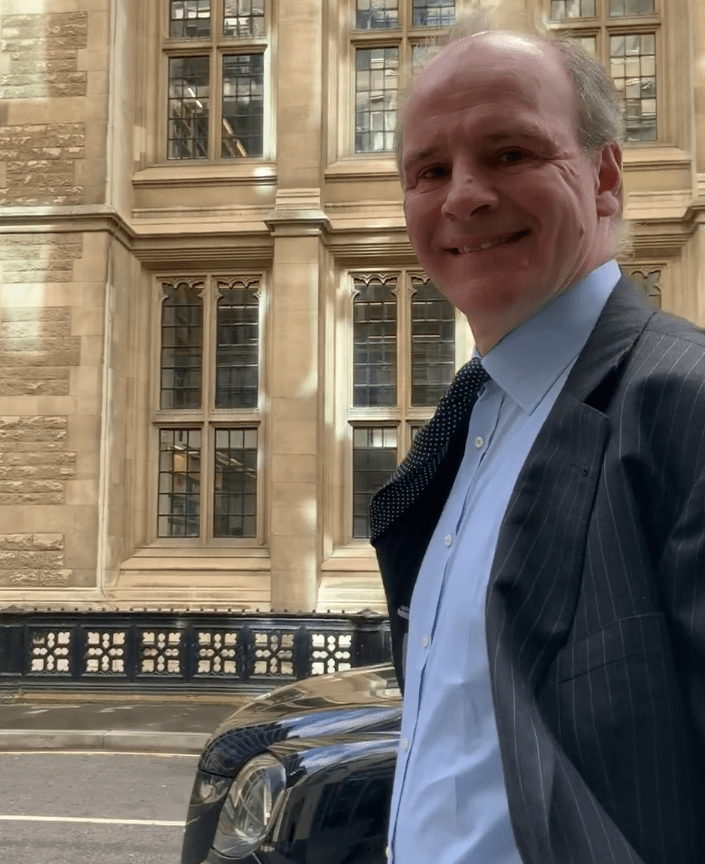
In 2016, Mr Andrew Jonathan Milne, described in court papers as “an experienced practising solicitor in the City of London”, took out a series of crowd funded loans facilitated by Open Access Finance Ltd t/a Unbolted.
Behind these loans were 612 ‘unique lenders’ within which at least 604 were ordinary members of the public. A question mark hovers over the exact status of the remaining eight lenders.
It is accepted that as the entities lending the money were limited companies, these remaining eight lenders can accurately be described as ‘corporate lenders’. The confusion arises by whether these entities can be described as commercial lenders, and if so, what arises from this new determination.
The barrister representing Open Access Finance, Mr Iain Macdonald, told the court during a substantive hearing back in March 2021, which was covered by mouseinthecourt, that his client wished to clear up this confusion prior to trial.
We were told that the claimant, Mr Milne, had made an application to amend his Particulars of Claim to argue that each of the eight corporate lenders “was acting in the course of a business“. If this proposed claim could be successfully argued, it was said the claimant intended to plead that these now-reclassified ‘commercial lenders’ would by virtue of their commercial status breach certain provisions within the Consumer Credit Act and the Financial Services and Markets Act. This breach, it was expected to be argued, could render the Loan Agreement unenforceable.
The issue of whether a small number of corporate lenders acting in a commercial capacity could ‘pollute’ the loan by unenforceability is a particularly important one with potential ramifications across the entire P2P industry. It is understood that the FCA had not been invited to make submissions to the Court on this application.
This proposed claim was resisted by Mr Rito Haldar, director of the first defendant, who in written submissions made to the court said:
“Mr Milne seeks to join all eight of the corporate bodies, and to exclude them from the current representation order, which would result in a total of ten Defendants. The First Defendant is concerned that such an order would produce unwieldly and costly litigation, in a claim which is of low value”
The Court ordered in December 2020 a preliminary hearing be held to decide the following issue:
“Whether the involvement of any commercial lender (i.e. a lender acting in the course of a business or by way of business) affects the entirety of borrowing on that occasion by the Claimant from all of the lenders or only the amount lent by a commercial lender”.
This one-day-hearing was held remotely in March 2021 and Deputy Master Marc Glover, the procedural judge dealing with the matter, handed down his judgment some 295 days later.
Critical of the approach taken by both parties DM Glover said:
“The Claimant’s Skeleton Argument for the hearing did not provide a list of essential reading, or a time estimate for pre-reading. … There was not an agreed: chronology; schedule of law, or; schedule of facts. The parties’ Skeleton Arguments indicate a degree of disjoint in their approach to the preliminary issue. …What was clear from the parties’ written and oral submissions is that the preliminary issue was either something of a Trojan horse, or poorly considered, but in either case it presents risk to a court seeking to grapple with that preliminary issue.”
Further criticism of Open Access Finance’s approach followed – “What is also striking is the lack of detailed focus (in comparison to the Claimant’s Skeleton Argument) in the Defendants’ Skeleton Argument on those issues that arise for consideration by a Court on interpretation of contractual documentation.”
“The Claimant’s Skeleton Argument continued to dedicate 13 paragraphs of detailed argument relating to the “s.18” issue, with reference to various authorities in the joint bundle of authorities. In the event, Mr MacDonald indicated in his oral submissions that no point was being advanced in relation to s.18 of the CCA 1974. However, this matter illustrates the lack of cohesion in the parties’ understanding of one another’s position as to the scope of the preliminary issue and accordingly the extent of the argument required to resolve the preliminary issue.”
Legal arguments had been made to the court over “whether the preliminary issue was appropriate for determination” but “having heard oral submissions in relation to the preliminary issue, the Court’s concerns regarding the suitability of the preliminary issue for determination were not assuaged, but were amplified.” Oh dear!
Further criticism was made later in DM Glovers 27-page Judgment:
“The parties did not seek to agree a schedule of facts for the safe determination of the preliminary issue. There is accordingly a lack of clarity as to what facts are, or are not, considered relevant to the preliminary issue, including which facts are in dispute between the parties, and accordingly which might first have to be resolved at trial”
“In this case, the parties’ invitation to the Court to venture onto the minefield without an agreed map, presents a “treacherous shortcut” which the Court is not willing to take. That concern is amplified by the fact that the parties seem not to have reached an understanding before the hearing on how to plot the map, or on which way is North”.
“The lack of an agreed schedule of facts, and the presence of ambiguity in the preliminary issue, present an obstacle to an assessment as to whether facts which are not agreed might impinge on the value of the preliminary issue”
“In my judgment it is reckless for the Court at this juncture, and on limited submissions, to determine core matters which may tie the hands of the trial judge on wider issues in the Claim”
“The Court is concerned that the parties have not properly formulated or considered those facts or matters of law which are agreed, or which are disputed, that are relevant to the preliminary issue. The Court is concerned that a determination may provide unexpected and unwelcome conclusions that have consequences to a party’s case that were not envisaged or accounted for by that party before embarking on the preliminary issue”
“In my judgment, the costs that have been involved in addressing the preliminary issue, even assuming that issue had been narrowly constructed, should have weighed heavily against the issue having been advanced.”
DM Glovers final conclusion – “For the reasons detailed above, the Defendants’ application for determination of a preliminary issue is dismissed”
Settlement?
DM Glover considered this possibility in his Judgment stating: “In that [Andrew Milne] has an objective of destroying Open Access, that does not provide a stable foundation for believing settlement is possible in this case.”
The judge explained his reasoning:
“this litigation has a particular feature which tends to weigh against a settlement being reached between the parties. Mr Justice Fancourt in his judgment at [2020] EWHC 1420 (Ch) addressed this feature between [11]-[12] as follows:
“11. The Chief Master referred to the Claimant as being involved in a campaign. It would be a concerning letter for anyone to have written, but the Claimant is an experienced practising solicitor in the City of London. The letter caused grave concern to the Chief Master and evidently influenced his decision not to order disclosure of the names and addresses of the individual lenders and make a representative order.
12. In paragraphs 15 to 17 of his decision he said as follows:
“The approach in the letter clearly suggests that Mr Milne’s objective is to create as much difficulty as possible for the defendant with a view to destroying it. He says so in terms. Furthermore, he gives clear notice that it is his wish that criminal proceedings are brought against the directors and officers of the defendant. In addition, if that were not enough, he raises the spectre of individual lenders being the subject of proceedings which might lead to their bankruptcy”.
At page 22, he instances a lender, identified as 75BE594, and says:
‘He is probably a retired civil servant with a nice little house somewhere who may find an order for costs of over £100,000 being enforced against him and his home at which moment Rito Haldar and Ashwin Parameswaran are going to become quite famous for having completely wrecked the entire peer-to-peer lending industry and the Unbolted fraud which will no doubt lead to each of them being recognised as the Bernie Madoff of peer-to-peer lending'”. “
Case History
5th March 2019
Claim Form Issued and an Injunction preventing sale of the underlying pledged goods at auction Granted
8th March 2019
Mr Justice Nugee discharged the interim injunction by consent
10th April 2019
The Claimant issued an application for specific disclosure (seeking the details of all lenders), relief from sanctions (for non-compliance with the Consumer Credit Act), and an extension of time for service of his Particulars of Claim to 14 days after the provision of lenders’ details.
22nd May 2019
A hearing before Deputy Master Arkush at which the Claimant’s disclosure application was adjourned, and he was ordered to file and serve draft Particulars of Claim by 2 July 2019 “setting out with appropriate particularity his claims against: a. The Defendant; and b. The lenders on whose behalf the Defendant acts as agent, to include all causes of action on which the Claimant relies”.
10th September 2019
The Claimant’s disclosure application came back before the Court. Chief Master Marsh declined to order disclosure of all lenders’ details, and gave permission for Open Access to act as the representative of all the lenders with whom the Claimant had entered into contracts through the Platform. The Court’s judgment on that occasion is reported online. The Court further ordered that the Claimant was to file and serve an Amended Claim Form by 27 September 2019.
27th September 2019
The Claimant filed his Amended Claim Form to name Open Access as the Second Defendant in a representative capacity.
12th March 2020
There was an appeal against the September 2019 order, which came before Mr Justice Fancourt on 12 March 2020. The Court’s judgment on that occasion is reported online. The appeal was allowed to the extent that Mr Marek Szymanski was substituted as the representative for the group of lenders, in place of Open Access, and the details of corporate lenders were to be provided to Mr Milne.
24th March 2020
The matter came before Deputy Master Nurse for a Cost and Case Management Conference. The order on that occasion provided for the adjournment of the CCMC to 3 September 2020. It is clear that this adjournment was to provide the Claimant with an opportunity to advance prospective applications to add further parties (i.e., the corporate entities), and to make consequential amendments to his pleaded case.
21st May 2020
The Claimant applied to join eight (corporate) defendants, and for permission to amend the Claim Form and the Particulars of Claim.
7th July 2020
The First Defendant applied for the determination of a preliminary issue. The time estimate provided on the Application Notice was 3 hours.
4th December 2020
The Court ordered by consent and without a hearing that a CCMC listed to be heard on 7 December 2020 was vacated, and that the Claimant’s application dated 10 April 2019 was adjourned generally
31st March 2021
A 1-day hearing was heard remotely before DM Glover.
20th January 2022
The Judgment of DM Glover is handed down by the court.
IN THE HIGH COURT OF JUSTICE
BUSINESS AND PROPERTY COURTS OF ENGLAND AND WALES
BUSINESS LIST (ChD)
Case No: FS-2019-000004
(1) ANDREW JONATHAN MILNE
-v-
(1) OPEN ACCESS FINANCE LIMITED
(2) MR MAREK SZYMANSKI as representative of those lenders who lent to the Claimant under the loans listed in Annex A to the Particulars of Claim
 Mouse in the Court
2 thoughts on “Unbolted: Court refuses to take “treacherous shortcut” across minefield without a map”