
“fine words butter no parsnips” said Lord Justice Toulson in his infamous opening paragraph of a judgment on open justice.
But as HMCTS publish ‘a guide for members of the public’ on ‘How you can attend or access courts or tribunals’ the mouseinthecourt criticises the new guidance as unhelpful, devoid of any tangible detail, and in some cases just plain wrong.
The new guidance published by His Majesty’s Courts and Tribunal Service, dated 29th December 2023, was seemingly published in response to the recent MOJ consultation on Open Justice.
The consultation, in its ‘Call for evidence‘ page explains: “In our response to the JSC’s inquiry into open justice, we committed to publish a charter that summarises the existing rules that facilitate public access to court and tribunal hearings and information. We will publish this charter later in 2023.“
As I said in written submissions any such charter “must, in my opinion, go for consultation first.“ This didn’t.
Whilst the commitment was for a ‘charter‘ (Noun, a formal statement of the rights) what we’ve ended up with is ‘guidance’.
The result is a mess of a document that fails in any meaningful way to be of assistance to non-party observers. It is awash with non-specific statements which are wholly out of place in a legal system which is founded on a system of rules and regulations.
The curse of vagueness
“Most court and tribunal hearings usually take place in public...you may be able to observe a hearing“
‘Most’, ‘usually’ and ‘may’ are not helpful words.
There is no assistance provided to the reader as to the myriad of procedure rules which dictate whether a non-party can or cannot attend a hearing.
For instance, can I attend a mortgage fraud case in the county court?
When this arose the ability of the mouseinthecourt to quote Civil Procedure Rule 39.2 off-the-cuff meant I had a response when I was incorrectly told by security officers “you can attend but with permission from the judge and with the consent of both parties”.
The new guidance would not have been of any assistance in this situation.
How about this possession case at the Stratford Housing Centre with ‘private’ in the hearing type…is this open to the public?

Yes – it is. Private refers to the type of rental agreement not whether the public are restricted although you won’t be able to assert the right to observe by relying on rules in the guidance.
How about attending my colleagues employment tribunal hearing? Or my neighbour who is taking their builder to the small claims court? Or my friend who is self-representing in the Court of Protection?
This guidance which purports to “help you understand your rights” is silent on these most basic of points.
Court lists

This section is materially deficient.
The majority of court lists, and some 600 are published daily, are only available on the built-for-legal-professionals CourtServe website.
The linked-to ‘Courts and Tribunals Hearing Service‘ only contains lists for hearings in Milton Keynes, Oxford, Reading, High Wycombe and Slough. That’s only five court lists.
Selective copy and pasting

In this section we can see where someone has done a bit of copying and pasting from the criminal practice directions to the guidance.
I note that a key piece of information, in 2.2.1, which places a positive obligation on the court to facilitate access, has not been included. Neither is the corresponding entry from the civil procedure rules.
Crim PD 2.2.1: “It is the court’s responsibility to ensure that members of the public can, in so far as possible, have access to courtrooms to observe proceedings.“
Civil PR 39.2(2A): “The court shall take reasonable steps to ensure that all hearings are of an open and public character, save when a hearing is held in private.“
This should be basic stuff in a guide that purports to “help you understand your rights when attending court or tribunal hearings as a member of the public“, but instead is missing.
Wishful Thinking

This sounds ideal but most courts do not have staffed reception desks — either to assist defendants, witnesses, complainants or indeed non-parties.
Laptops
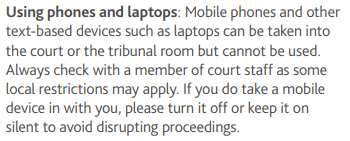
The unevidenced assertion that laptops cannot be used is just wrong and I have no idea where this purported restriction came from.
Paul Magrath, Head of Product Development and Online Content at the Incorporated Council of Law Reporting described this as “Misguidance” on twitter.
Celia Kitzinger, who is a co-director of the Open Justice Court of Protection Project, and a prolific blogger said:
“This restriction has never been applied in any of the COP hearings I’ve observed in court…I’ve always taken in a laptop and typed in my notes and used internet to locate case law.“
This site reported on changes to the criminal procedure practice directions earlier in 2023 which removed reference to making notes using “silent electronic means”, although it now doesn’t prohibit it. Until a few months ago the position was:
“As long as it does not interfere with the proper administration of justice, anyone who attends a court hearing may quietly take notes, on paper or by silent electronic means…“
The new HMCTS guidance has no legal standing so it’s difficult to see why it purports to impose such a restriction or on what basis.
Live-tweeting
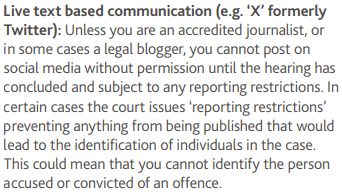
There’s a few things wrong with this paragraph. Firstly, is the reference to accredited journalists — we don’t have accredited journalists in this country. We have a private limited company which accredits members of the press, including camera operators, truck drivers and sound recordists. (You can read more of my opinions on press cards here).
The possession of a press card is a wholly inadequate method for identifying whether someone should have the right to contemporaneously report court proceedings.
The term ‘legal blogger’ is also strange. We have legal bloggers as a defined group in the family courts, but as family hearings are by default in private it would be odd if this guidance said they could post on social media without making an application to the court.
The practice guidance issued by the then Lord Chief Justice of England and Wales Lord Judge referred to legal commentators, not bloggers, and it may be that a borked copy and paste resulted in this anomaly appearing.
The use of undefined terms leads to confusion. It may well be that this confusion is deliberate as it allows HMCTS to say “well of course we haven’t restricted it to just press card holders…“.
We’re also told that the restrictions apply until the “end of the hearing” which is also wrong (ie there’s nothing stopping someone leaving the court room to tweet or tweeting during a break).
Don’t get me wrong, we do have fruitcakes attending court for the purpose of causing mischief (see: sovereign citizens & others) – but these groups have little interest in producing fair and accurate contemporaneous reports of hearings.
Access to information

Here we’re told non-parties are “entitled to receive information about what’s happening“. Later on we’re told we “may have a right to the information, depending on the court’s or tribunal’s rules“.

The use of the word ‘may’ rearing its ugly head again.
There are no links to any of the procedure rules which apply, or about how the rules differ between jurisdictions.
An issue I’m experiencing at the moment is that I’m seemingly entitled to access a written judgment in a civil case but not in an insolvency case. How does this guide assist me? It doesn’t.
The guide fails to explain the importance of skeleton arguments in civil hearings and how, as Hale P said, “it is difficult, if not impossible, in many cases, especially complicated civil cases, to know what is going on unless you have access to the written material” meaning “the default position is that the public should be allowed access, not only to the parties’ written submissions and arguments, but also to the documents which have been placed before the court and referred to during the hearing“.
[Source: Cape Intermediate Holdings Ltd v Dring (Asbestos Victims Support Groups Forum UK) [2019] UKSC 38 (29 July 2019) 43+44]
The guide is completely silent on what is a vital route to access information about hearings.
Conclusion
In a word – disappointed.
The status of this guide is merely to provide advice, it doesn’t purport to replace any of the multiple procedure rules which exist or the voluminous amounts of case law which has come into existence since the 1913 case of Scott v Scott.
This is regretfully a missed opportunity to publish a definitive useful guide setting out the a considered position that can be used by observers across the entire justice system. It is even more regretful given what I say is the inaccurate and incomplete information contained within.
It’s another document to add to the myriad of information about open justice. Eg see this list of HMCTS Staff Guidance.
The December 2022 “Reporter’s charter” was another missed opportunity. Only two types of court hearings are mentioned – criminal and civil – and again the document is devoid of tangible details and is materially wrong in places. It also purports to assert that the only type of ‘reporter’ in the court system are solely those who produce commercially rewarding content.
What we could have had…
In 2014 a ‘right to report’ council meetings was introduced by Eric Pickles MP “in a boost for local democracy and the independent free press“. It was boasted that the “press” would be defined in the widest terms – “including traditional print media, filming crews, hyper-local journalists and bloggers“.
Mr Pickles said “Local democracy needs local journalists and bloggers to report and scrutinise the work of their council, and increasingly, people read their news via digital media” as he unleashed “a plain English guide of practical information on how the public can exercise their new rights“.
The guide is 33-pages-long.
It’s such a shame we don’t have an equivalent source of information for the courts. Given the publication of this guidance there is unlikely to be the political appetite to revisit the topic of open justice for some time.
 Mouse in the Court