
A recent consultation by the Tribunal Procedure Committee on non-party access to documents has concluded that no change is necessary, an FOI request made by the mouseinthecourt has revealed.
This is despite an acknowledgement that there is no rule expressly providing a right of access by third parties, unlike the Civil Procedure Rules (CPR 5.4C) which expressly provide for access by third parties to documents in proceedings.
“We would urge the bodies responsible for framing the court rules in each part of the United Kingdom to give consideration to the questions of principle and practice raised by this case“
So concluded Lady Hale in the infamous 2019 Supreme Court judgment of Cape v Dring.
Her ruling confirmed “the default position is that the public should be allowed access, not only to the parties’ written submissions and arguments, but also to the documents which have been placed before the court and referred to during the hearing“, subject of course to certain conditions.
It was against this backdrop that in 2020 the Senior President of Tribunals caused questionnaires to be sent to the Chamber Presidents. This sought their views on whether the right to access Tribunal documents, upon the application of third parties, should be subject to specific tribunal procedural rules.
The responses from the Chamber Presidents to the 2020 questionnaires “were not generally in favour of rules being made, although they expressed a wide range of views“.
Our reporting comes from a freedom of information act request made by the mouseinthecourt, which we note was subsequently “briefed” to the committee:

As a result of the 2020 questionnaire the then Senior President of Tribunals indicated that he would issue a Practice Direction on the subject although this commitment was later dropped.
Roll forward a couple of years and we’re told that “requests by third parties with a significant commercial interest in the outcome of proceedings in the Tax Chamber have generated complex and expensive satellite litigation in that chamber, and parties have sought costs against unsuccessful applicants for disclosure.“
The case of Cider of Sweden Limited v HMRC and Ernst & Young LLP [2022] was given as one example of this. We’re told that Judge Poole, who dealt with the Cider case “wrote to the [Tribunal Procedure Committee] asking for consideration to be given to potential rule changes“.
At the end of 2022 the committee sent out another questionnaire to each chamber president asking “whether they now agree that the TPC should consider whether to introduce tribunal procedural rules in relation to requests by third parties for access to documents in proceedings“
The responses to this 2022 questionnaire are published in full below.
“We firmly reject the submission that the principle of open justice applies with less force in the tribunals than in the courts.”
Bacon J in HMRC v The Taxpayer [2024] UKUT 12
What’s next?
This is not the end of the subject. The Civil Procedure Rule committee have also been considering the ramifications of the Cape v Dring judgment.
On the 5th March 2021 the CPRC agreed to set-up a sub-committee to consider whether changes should be made to the rules governing access to Court documents. Two years of dither and delay followed with confusion over membership and whether other rule committees should be involved.
The CPRC have repeatedly ignored requests by the mouseinthecourt for updates on their progress and have ignored an FOI request made by this blog too. See this decision notice dated December 2022 which has still yet to be complied with by the CPRC.
Finally, in May 2023, it was resolved to form a cross-jurisdictional sub-committee to consider the matter instead.
Mrs Justice Joanna Smith, chair of the tribunal rule committee, reportedly said in a meeting that there “may be a possibility that once the sub-committee have concluded their endeavours and reported their thinking on potential rule changes to the CPRC, the TPC may need to revisit this matter.“
She added: “It will certainly need to discuss the sub-committee’s observations and any recommendations and subsequently consider any implications for potential future tribunal rule changes.“
Will anything change? Watch this space.
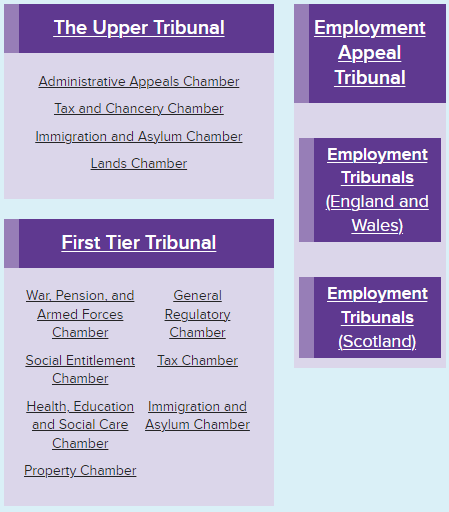
Structure of the UK Tribunals System (It’s not known why the mental health tribunal is missing)
– The responses –
Employment Appeal Tribunal
We consider it to be a real benefit that these matters are governed by the EAT PD – which is far easier for us to change/amend. We would be concerned if our procedures in this regard were to be put into rules that don’t allow the same degree of flexibility (this is a bit of an issue for us at present as there is quite a lot we would like to change in the EAT Rules but understand this is not something that is likely to be on anyone’s agenda for the foreseeable future).
Administrative Appeals Chamber
Some overall guidance would be useful.
Health, Education and Social Care Chamber
The [Chamber President’s] general position remains that no rule change is required
Immigration and Asylum Chamber
Having considered the issues we see no reason to change the responses made as recently as 2020.
War, Pension, and Armed Forces Chamber
In the absence of any Senior Presidential Guidance, we would welcome some clarity from the Rules to provide a process for dealing with such applications. I do not anticipate that we will get many applications from 3rd parties for access to the documents before the Tribunal and as the vast majority of the documents we see are medical or service records and contain sensitive personal information it is likely that request will be denied. The Ministry of Defence, who produce the bundle of documents for the hearing take a highly conservative approach to disclosure and redaction and are likely to object to the majority of such applications. We do not have costs in our jurisdiction so there is no question of any interaction with the costs rules.
Mental Health Tribunal
No change to our previous replies. We have had applications to disclose to [Court of Protection] so that they can decide applications for DoLS orders. We have also had applications from criminal solicitors or the CPS for use in criminal proceedings.
We considered an application to disclose our decision to a victim in a restricted case. The application was refused. We are awaiting the outcome of judicial review and are hoping to have the decision before Christmas. We also have a new protocol with the COP when a RPP is awaiting a DOLS order from COP. We will be sharing the decision with COP – probably with the consent of the patient’s representative and only for the use by COP as evidence in deciding whether to grant a DoLS order.
Lands Chamber
The response of the Lands Chamber from 2020 is also unchanged. As with the Property Chamber the issue is not one which comes up much in the Lands Chamber. Speaking only for the Lands Chamber, our current view is that we do not need a rule change to deal with this issue when it arises.
Tax and Chancery Chamber
We don’t have anything to add for the Upper Tribunal (Tax and Chancery Chamber). The issue has arisen a few times in financial services cases, but the general view is that we don’t currently need a rule change our end to deal with this. We understand that there appears to be a lacuna in the costs provisions in the FTT, but the UT rules are not constrained in the same way as the FTT rules, so if we did get a costs application we would have the power to consider it.
Property Chamber
The Property Chamber response is unchanged. We receive very few requests and given that we are party v party and deal with quite a number of county court transfers, then probably we should be aligned with the courts.
Social Entitlement Chamber
In general SEC’s position has not changed. In all jurisdictions of SEC the appeal papers are likely to comprise largely sensitive personal information or information that is otherwise confidential. Such requests are considered on a case by case basis and the views of the parties may be sought.
CICT hearings are by default held in private and so the documents are likely to be confidential.
In all jurisdictions of SSCS the request may be declined if the information requested is sensitive personal information. Alternatively, documents may be redacted or anonymised
Tax Chamber
The FTT Tax Chamber has experienced an increase in such requests and the issue of costs has been raised in some cases where applications have been unsuccessful. We believe that greater clarity in relation to applications and their consequences, eg costs of providing documents and costs of parties who successfully resist such challenges, would be desirable and that this might be achieved by specific provision in the Tribunal Procedure (First-tier Tribunal) (Tax Chamber) Rules 2009.
General Regulatory Chamber
The GRC’s position hasn’t changed. We do see some requests from journalists, and we send out a copy of our Guidance which, as a first step, requires a request to be made of the party who owns the documents. The requests rarely go further, and the system works well. On only a couple of occasions this year we have had to make decisions in relation to applications by journalists, and one from Lexus Nexus. In one of our bigger cases (where about 250 remote observes watched a face to face hearing), the parties (with the Tribunal’s permission) published papers online so that the observers could follow the proceedings.
Immigration and Asylum Chamber (UT)
The position at UTIAC has not changed since the last response provided by Lane J to the earlier consultation. This has not caused issues for UTIAC as there are very rarely any requests and such as they are they have been straightforward to deal with.
Employment Tribunals(Scotland)
Any request during a hearing would be dealt with by the presiding judge. Any other requests would be referred to the President’s office and dealt with by the President or Vice-president. There is no specific published guidance although there is some reference in the Practice Direction and Presidential Guidance on Remote Hearings
 Mouse in the Court