
An HMCTS ‘guide for members of the public’ on ‘How you can attend or access courts or tribunals’ was criticised by the mouseinthecourt as unhelpful, devoid of any tangible detail, and in some cases just plain wrong.
The Courts and Tribunals Observers’ Network described the document as paying “lip service to the principle of open justice” adding “its wording is too imprecise and its content too insubstantial…it appears to contain some serious inaccuracies“.
Further information about the guidance, and what we say are its problems, can be read in ‘Fine words – but new HMCTS public guidance falls short‘.
A freedom of information act request made by the mouseinthecourt has revealed that the document did indeed go out for consultation prior to publication.
Cost of the guidance?
We were told there are no costs associated with producing the main guide. But that the cost of producing an Easy Read version, which is being undertaken by an external supplier, is £127.56.
Who made the guidance?
We’re told the HMCTS Communications Team compiled the document, which “summarises existing policy, legislation, guidance and rules created by other parts of the justice system, including jurisdictional Procedure Rules committees.“
How were court staff told about the guidance?
We’re told the following was e-mailed out. We dispute the use of the word “uncontentious”.
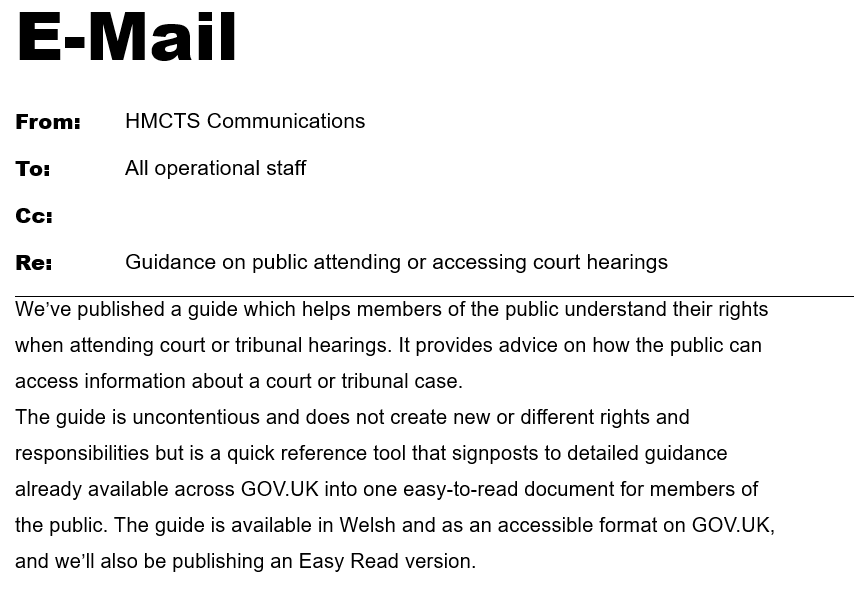
Who was consulted?
We’re told that as the guide purportedly did not create any new policy it was not subject to a formal public consultation.
HMCTS did, however, share a draft of the document with the following members of the Public User Engagement Group and invited them to provide comments:
- SupportThroughCourt
- LawForLife
- TransformJustice
- VictimSupport
- CassPlus
- CitizensAdvice
[The mouseinthecourt notes that no members of the public are part of the Public User Engagement Group]
What responses were received?
We’re told that the responses are “anonymised … to avoid any organisation/individual from being identified“. No justification was provided for this redaction.
The full responses can be read in the FOI answer.
One worrying remark was: “Members of the public don’t need permission to enter the public gallery – at least in a adult criminal court”
This raises the question – did the draft guidance say we did?!
 Mouse in the Court