
As the ‘Veteran Law Project’ is launched by former army officer Charlie Radclyffe, the mouseinthecourt dropped into an Armed Forces Compensation tribunal hearing to see what’s going on.
“The Veteran Law Project aims to improve the experiences of service personnel and veterans harmed by their military service” says the blub on its homepage with “Open justice at War Pensions and Armed Forces Compensation Chamber tribunal hearings” cited as one of their areas of work.
Open justice – broadly speaking the idea that the decision making process in our courts and tribunals should have an appropriate degree of transparency – is also an area of my work too.
I’ve often felt tribunals are slightly neglected when it comes to discussions on open justice with the main focus on crime, family and civil matters. At least one high court judge would seem to agree with me:
“We firmly reject the submission that the principle of open justice applies with less force in the tribunals than in the courts.”
Mrs Justice Bacon in HMRC v The Taxpayer [2024] UKUT 12
Tribunals cover a wide range of jurisdictions as shown in this judiciary issued organogram (although it’s not known why the mental health tribunal is missing).
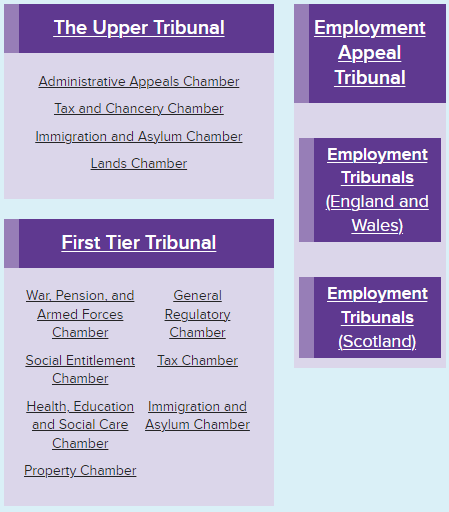
Structure of the UK Tribunals System
War pensions and armed forces compensation hearings are not something that I’ve given too much thought about. I was surprised to see just how many hearings were present on the weekly list – some 32 for the week ending 2/2/24.
With the default position that “all hearings must be held in public” I decided to ‘drop in’ on the morning list of Judge Edward Solomans.
[This court of appeal case at para 32 established that if there was “no chance of a member of the public dropping in to see how Industrial Tribunals (as they then were) were conducted” then the hearing should be regarded as being held in private].
Accessing the hearing
09.06: I asked “to observe the list for judge Edward Solomons today please.“
09.26: I was told “We will have to have permission from the Judge and the panel first. And will have to come back to you on this“
09.52:

Now, I don’t think this is quite correct. If the default position is that the hearing is in public then I should at least be joined to the hearing to understand any objections as they are being made, and indeed be able to reply to them.
In any event, I’m was joined to the remote hearing at 10.04 and told by the judge that there is “no objection” to my attendance. Phew.
The introduction
We began with the appellant, Mr AF, asking the Judge how he should be addressed. We’re told “Judge is the correct title but I’m not proud…I did have someone refer to me at mate once“.
Civil Litigation Brief has a helpful guide for those who are interested.
I should note that the mouseinthecourt has made an editorial decision not to name the appellant but to refer to them by their initials AF.
“Proceedings are relatively informal and nobody wears robes or wigs” explains the judiciary website and I’m pleased to say I was impressed how Judge Solomans dealt with the appellant in explaining the rules in a fairly relaxed manner.
As one example we’re told we shouldn’t “get into hot water” by recording the hearing.
The appellant is told if the connection drops out “we will wait for you to reconnect” and if there are “insuperable problems you can connect through the phone“.
“One further routine question we ask to everybody in these cases, well at least I do, is do you need an adjustment…anything to make the hearing any easier?“. ”No” came the response.
Mr AF is reassuringly told “we understand how stressful these hearings are so if you need a break do say so“.
Explaining the structure of the hearing the judge says the tribunal will “hear from the two representatives and more importantly hear from you“. The appellant is advised “if you don’t know the answer please don’t guess, people get into all sorts of trouble by guessing“.
The issues
By way of introduction the judge explained that it was agreed that Mr AF’s service in the forces “was the predominant cause of your wrist injury“.
Mr Glyn Tucker, who in the absence of an introduction seemed to represent the appellant, referred to medical evidence which described how Mr AF has “trouble holding knives or screwdrivers” in his right hand.
It was said the causes of the wrist injury gave the appellant two possible awards of compensation – one for an overuse injury, and a second for a ligament injury.
Ms Gibson, on behalf of Veterans UK, described the procedural history but without sight of the underlying documents the mouseinthecourt found it difficult to follow and understand. Eg we were told the “column on page 1 explains that reasoning“.
Mr Tucker explained that there “may be a complication in considering” the appeal today – the compensation decision for the ligament injury was still only an interim one.
The judge discussed the matter privately with his fellow panel members - Dr Gopal Sharma and Ms Celia J Harvey.
Returning after 14-minutes the judge explained “the panel has had the opportunity of discussing the arguments put forward so far“.
Because it is “impossible to distinguish” which of the two injuries caused the loss of grip in the right hand “we have decided it is right to adjourn this appeal” pending the interim decision to be made final.
It was said Mr AF had “no current right of appeal” to challenge the interim decision.
The tribunal directed that the appeal should be relisted “not before a date in six-months-time“.
Concluding the hearing Judge Edward Solomans said to Mr AF “in the nicest possible way I hope that your injury does recover so you’re not entitled to the award“.
Thoughts
The Open Justice Court of Protection Project has had an enormous impact on transparency in what was once described as a secret court. I wish Charlie Radclyffe and the Veteran Law Project all the best in their endeavours to open up the WPAFC tribunal.
Of particular concern in this case was some of the time delays involved. Reference was made to a date in 2020 in the chronology of the appeals and it now seems Mr AF faces another 6-month-delay, with no guarantee that the interim decision would have been made final then in any event.
Perhaps I don’t fully understand the complexity of the decision making process but it can’t be right that it takes almost 5-years for an award to be adjudicated on. Particularly in circumstances where the injury occurred in the course of serving the county.
I look forward to seeing some of these issues opened up and discussed by the Veteran Law Project in the near future.
Case ref: AFCS/00076/2023
 Mouse in the Court