
The Civil Procedure Rule Committee (CPRC) has confirmed that they did not consult on an open justice rule change in an FOI response that took over 500 days to process.
As part of an ongoing project looking at the transparency of decision making in the justice system, the mouseinthecourt has been examining the work of the various rule committees.
In December 2022 we reported that the CPRC was warned that continuing to ignore a Freedom of Information Act request would amount to a contempt of court.
The request concerned a rule known as PD51Y which we described as the introduction of “a mechanism that effectively removes the right of the public to access remote hearings“. The Incorporated Council of Law Reporting for England & Wales kindly hosted our write-up in a guest post on their blog.
Incidentally, the note from a CPRC meeting held in December 2022, citing the comments of “a blogger“, confirmed that PD51Y is to be removed.
The mouseinthecourt considers these minutes to be materially defective in accurately describing the provision actually in force at the time:
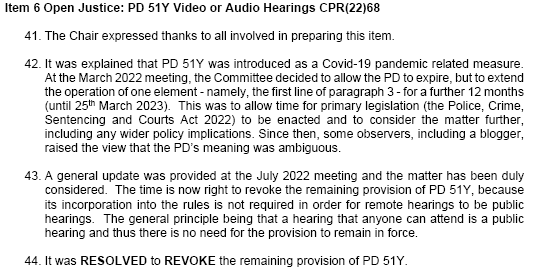
PD51Y actively gave the court jurisdiction to exclude members of the public on the basis that a press-card-holder had the ability to attend. Not did attend, but had the ability to.
The apology
In a letter dated 06/02/2024 the Civil Procedure Rule Committee Secretariat, who declined to give their name in the correspondence, said:
Thank you for your request dated 7th September 2022, which was received via the information Commissioner’s Office on 23rd January 2024. Please accept my sincere apologies for the delay in responding.
This appears to have been due to a fault in the email system at the time of your request and for some time thereafter, which appears to have had the effect that neither your original request nor subsequent correspondence, including that from the Information Commissioner’s Office, was received.
At the risk of going all Victor Meldrew – I don’t believe it.
I do not find it at all credible that an e-mail address that has been consistently used by the committee to receive correspondence over the past few years conveniently broke when receiving e-mails from myself and the Information Commissioner’s Office.
I consider this statement to be a fabrication.
The FOI Response
The full response to my FOI request is here.
The key point – “the CPRC can confirm that no formal consultation exercise took place“.
I’m told:
“There is no statutory requirement to consult prior to making practice directions. The statutory provision regarding consultation is at section 2(6) of the Civil Procedure Act 1997 which reads:
The Civil Procedure Rule Committee must, before making or amending Civil Procedure Rules, consult such persons as they consider appropriate, and meet (unless it is inexpedient to do so).
The Committee accordingly consults as it considers appropriate to the rules or amendments to rules in question; but while it also consults on practice directions where it considers this appropriate, there is no statutory requirement to that effect.“
The desire to draw a distinction between rules and practice directions is, I submit, entirely wrong.
“Civil Procedure Rules” are defined as the “rules of court … governing the practice and procedure [of civil courts]...”. (S1 Civil Procedure Act 1997)
A practice direction therefore falls within this definition and is therefore subject to the requirement to “consult such persons as they consider appropriate“.
See also this article by solicitor advocate David Burrows, which explains why practice directions are statutory and considered part of the rules.
I consider that the Civil Procedure Rule committee acted unlawfully when they failed to consult and I consider that the practice direction itself was an unlawful restriction on the Article 10 rights of the public to receive information.
We contacted the CPRC putting the above points to them and received no response. Perhaps their e-mail has stopped working again.
 Mouse in the Court