A litigation firm pursuing a £15m High Court claim against auditors Moore Stephens LLP has denied that its “case is vague, embarrassing and/or impossible for the Defendant properly to understand” in a court document exclusively obtained by the mouseinthecourt.
This site is financed by donations to the ‘Cheese Fund‘ or you can buy me a coffee here
Reporting by Daniel Cloake
✍️ We previously reported on the claimants case in ‘Lendy auditor caused £15m loss to investors, court papers claim‘.
✍️ We also reported that the defendant had been given an extension of time to file their defence in ‘Lendy auditor given new deadline in £15m negligence case‘.
✍️ We also reported on the filing of the defence statement in “Lendy auditor: ‘We made mistakes, but blame the dishonest directors’, defence statement says“

The Business and Property Courts where the claim has been filed
We are now reporting the filing of the claimants response to the defence. All three legal pleadings can be read here:

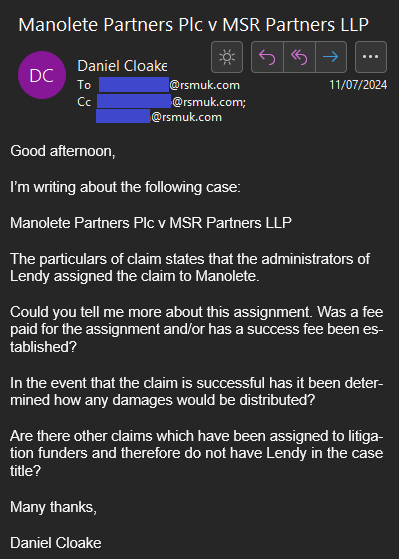
Details about the assignment of the claim
The claimant in this matter is Manolete Partners Plc who purchased the rights to this litigation from the joint administrators’ of the failed peer-to-peer lending firm Lendy.
In the eleventh Joint Administrators’ progress report, filed at Companies House on Jan 4th 2025, information regarding the assignment of this claim is revealed.
We have previously asked RSM to comment on the details of the assignment, which was absent from their previous progress report, but we did not receive a reply.
We’re told in the report:
“In early 2024, the Joint Administrators assigned certain claims the Company has or may have to Manolete Partners Plc (“Manolete”). We understand that Manolete have issued claims against the Company’s former auditors. During the period, time has been spent liaising with Manolete and their legal advisors.
“The terms of the assignment included an initial upfront sum of £20,000, and if successful, there will be potential further recoveries into the estate from net proceeds realised. The Joint Administrators are not in a position to provide any further details on this action.“
We don’t intend to summarise the whole of the 37-page-document forming the claimants response, written by top barrister Nicola Rushton KC, but it’s fair to say two main thrusts of argument are deployed.
1 – Hidden audit files
The conduct of the auditors, and their assertion that the underlying claim is difficult to understand, is critised on the basis of what is described as their “unreasonable refusal to provide disclosure of all or any part of its audit files“.
Several examples are given including that “at the start of the audit process, representatives of the Defendant had a formal meeting … at which, among other things, such areas of noncompliance were discussed” but “the Defendant has not disclosed its attendance note or records of that or any meeting“.
The rules for civil courts in England & Wales can require one party to provide documents to the other side in a process known as disclosure. The claimant says they reserve the right to make additional claims if and when these files are released to them.
2 – Duty to detect
In the auditors defence statement a big point is made that:
“The conduct of Lendy was driven by its directors and their conduct was the sole cause of Lendy’s actions as a matter of fact and law...Every allegation made by the Claimant that the financial statements were defective lies primarily against the Directors”
The claimants response is to say that this is simply wrong – the “actual or potential fraud by management was one of the very things they should have detected“.
Many examples are given throughout the response we’re discussing but they all share the same theme. It’s claimed that the auditors “should have approached all such expressions of opinion [made by Lendy] with appropriate professional scepticism and sought independent audit evidence to support the same, and it failed to act with reasonable competence in failing to do so.“
One specific instance that illustrates the point is whether the auditors should have relied on an e-mail sent by Mr Tim Gordon, 45, then a director of Lendy, purporting to contain accurate information about its dealings with the FCA. The auditors are accused of incompetence by blindly relying on his e-mail and failing to carry out their own investigation:
“insofar as the email of 14 February 2018 contained any misrepresentation, the Defendant cannot rely on the same to avoid its liability since any such misrepresentations were the very thing it was engaged to detect and would have detected, alternatively it would have
known the true position from its own enquiries, if it had been acted with reasonable competence.“
FCA investigation details revealed
One snippet of important information which came to light, nestled away at paragraph 30.2, are details of “the rapid actions of the FCA in April and May 2019“.
The FCA filed a winding-up petition against Lendy on May 23rd 2019 causing the company to place itself into administration the following day.
We’re told that FCA investigators were appointed “on 17 April 2019 … on the basis that there were circumstances to suggest that Mr Brooke (the then sole Director) was guilty of misconduct … and/or was in breach of the duty to act with integrity and/or was not a fit and proper person“.
Mr Brooke has consistently denied any accusations of wrong-doing and none of these claims have yet to be tested in court. The FCA have not made a public comment about the outcome of their investigation.
So what happens next?
The parties have until 24th January 2025 “to file and serve their respective Directions Questionnaires” at the court.
This is a form that both parties in a civil claim must fill out to provide information about the case. The court uses the information to decide how to proceed with the case.
The normal road map would involve the court scheduling a so-called costs and case management hearing likely to be held in the first half of 2025 based on the current availability of the High court in London.
At any point the claimant could choose to discontinue the claim, or the parties could decide the outcome between themselves and settle the claim.
We’ll aim to follow this case as it progresses through the court system. You can support us with the cost of this endeavour by buying us a coffee or donating to the cheese fund.
Case details
Manolete Partners Plc v MSR Partners LLP
Case Number: BL-2024-000191
MSR Partners LLP are represented by Clyde & Co
Manolete Partners Plc are represented by Gateley
 Mouse in the Court