The mouseinthecourt has been successful in a resisted application for access to witness statements and skeleton arguments during an insolvency trial.
The principle “that justice should not only be done, but should manifestly and undoubtedly be seen to be done” is often an unachievable ambition in the modern era, with the significant reliance on written documents in civil hearings hindering the ability of non-parties to understand the underlying issues in a case.
The practice of receiving evidence without having been read in open court “has the side effect of making the proceedings less intelligible to the press and the public” – a statement going back decades which was quoted with approval by the Supreme Court in the infamous 2019 case of Cape v Dring.
The practical realities of how non-parties can actually access court documents is one the mouseinthecourt runs into on a monthly basis. Whilst at the extreme end the threat of a judicial review can yield results, the time required to make an application, and have the court consider it, often makes the substance of the information required stale by the time it is received. The effort needed is often a prohibitive factor too.
The approach taken by His Honour Judge David Hodge KC, sitting as a high court judge, in the matter of Caterham Capital Limited, is one that should be applauded by advocates of open justice.
It was during the first hour of a two-day-trial that I found myself rather confused. With references to witness statements I couldn’t read, and skeleton arguments I couldn’t see, the trial quickly became impenetrable.
Knights PLC, the law firm representing the applicant administrators, declined to provide any written documentation to me necessitating an application to the court.
I hastily scribbled out a request to the judge, helpfully passed on by court staff, and the matter was instantly addressed by the judge as he re-entered the court room after a short break.
The transcript of what was said can be read here. [The judge has a remarkable memory to recall a similar application I made at a hearing in 2021].
The Judgment
In a 10-paragraph-judgment, approved by the court earlier this week, the judge recorded that my application was opposed by both respondents but “Nevertheless, this is a public hearing…“.
It is impossible for anyone observing the proceedings to understand how the case is being conducted by myself, as the judge, without being able to see the underlying documents.
The transparency of court proceedings is an important public interest.HHJ Hodge KC
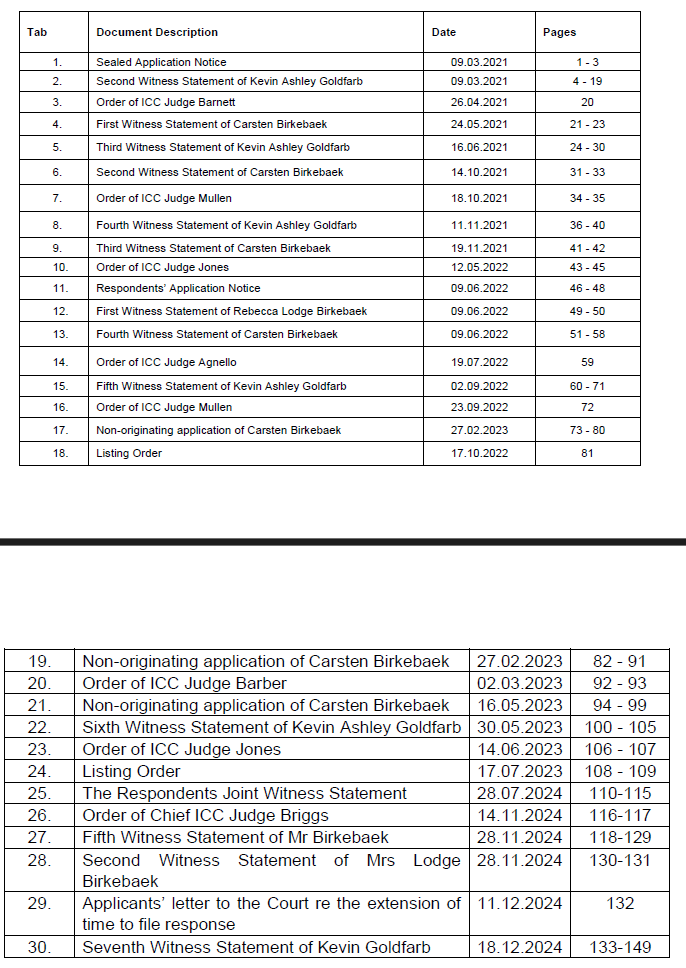
Granting my request for access to the witness statements and skeleton arguments the judge went one step further – and instructed that I should be given access to the entire core bundle, containing some 151 pages of material (the index of which, showing the depth of information made available, is shown here)
The judgment concludes:
“I emphasise that the disclosure of these documents should be limited in their use for the purpose of reporting the proceedings in open court in good faith and with reasonable fairness and accuracy.“
I hopefully achieved that requirement producing a long-form report of the proceedings called “Married couple hit by £500k bill as company funds used for “personal expenses”“. I was pleased to see this report generate some discussion on the AccountingWeb forums.
 Mouse in the Court