
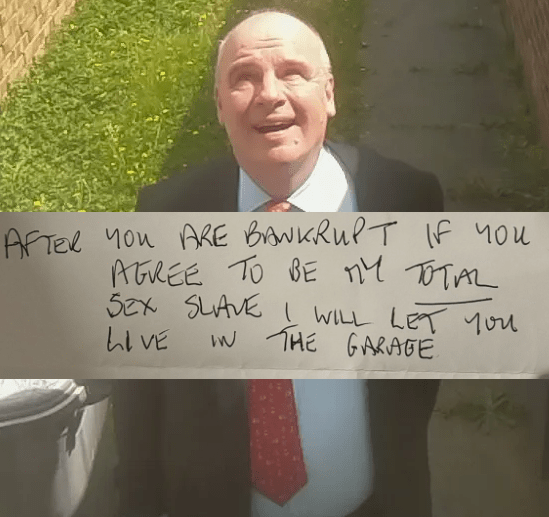
Solicitor Andrew Jonathan Milne delayed an official investigation into his alleged professional misconduct by overwhelming the regulator with complaints and threatening them with two injunctions seeking to prevent them from taking action, the mouseinthecourt can exclusively report.
We can reveal that the Solicitors Regulation Authority, which purports to maintain the high standards of more than 200,000 legal professionals in England and Wales, has been investigating complaints about Andrew Milne’s behaviour at least as early as 2016, and received threats of an injunction, to prevent them from taking formal action, in 2021.
Milne runs his own law firm, Andrew Milne & Co, which he uses to launch legal claims on his own behalf.
In November 2018 the SRA wrote to Milne with a so-called production notice demanding details of his legal disputes.
According to legal documents filed by the SRA, Milne lied to the regulator by failing to disclose action he was taking at the High Court, and he failed to produce complete client files in relation to three other cases.
In September 2020, the regulator sent him a letter setting out several other allegations of professional misconduct. These included ‘purposely frustrating the process by which the SRA was seeking to interview’ him, and that he had dishonestly claimed not to have entered into three loan agreements with a finance company, during a phone call.
The subsequent litigation relating to these three disputed loan agreements achieved Milne a settlement of £600k, he claimed.
In correspondence with the regulator Milne variously said he should ‘be nominated for an excellence award’, that the regulator was harassing him and should pay ‘compensation for their malicious actions’ and, if that wasn’t enough, that the regulator was prolonging their investigation into him in order to ‘put such additional pressure on him that he would die’.
Legal filings written by the SRA say that Milne sought to ‘purposely frustrate’ their investigation by filing over 180 complaints, which ‘were not complaints but simply uncorroborated false statements or unreasonable requests’ to the extent that Oliver Sweeney, then Head of Legal and Enforcement at the SRA, had to issue a contact restriction against him.
This is a hefty post; you can jump forward to read more about how the SRA has become embroiled in a quagmire of regulatory paralysis, or you can keep reading to learn more about this man and his conduct.
Sheffield, Horwich and Southport
Andrew Milne acquired at auction the freehold interest over long leasehold houses in areas including Sheffield, Horwich and Southport, and has been demanding large payments as settlement for alleged alterations and breaches of covenants.
In several instances it is understood the solicitor has made threats of lease forfeiture unless payments of £15,000 were made in order to settle an alleged breach of the lease. This apparently included instances where uPVC guttering had been installed, or where a door had been painted.
The mouseinthecourt has spoken to dozens of individuals who have been in touch over the past two years, and raised concerns over the conduct of this solicitor with both the level of aggression shown in correspondence, and the amounts of money demanded, being prime concerns.
One individual in Sheffield, where over two hundred leasehold properties have been purchased by Milne, spoke to us on condition of anonymity.
They have shown us correspondence which details a demand by Milne for £25,000 unless part of their property is demolished. The demand came with a draft particulars of claim, and a threat that if the offer was not accepted within 14 days then the cost to purchase the freehold would increase to a six-figure-amount, and High Court proceedings would immediately follow.
The leaseholder told us Milne ‘is causing a lot of stress’ and ‘scaring a lot of people, old vulnerable people and at least one with suicidal thoughts’.
Another leaseholder has shown us correspondence from the solicitor in which it is said the costs of the threatened litigation would exceed the value of the property. The leaseholder is told that locksmiths will be sent to the property later that week unless a large payment is made.
The Sheffield Tribune has also been contacted by affected individuals and are to be commended for their recent coverage. Milne reportedly told them ‘we will definitely bring proceedings for Defamation and Malicious Falsehood if you publish such complete and malicious lies’.
The threats of potentially ruinous defamation litigation have unfortunately been a decisive factor in our decision to stop publishing about his cases in 2024 … until now.
SLAPP-ing the Mouse in the court
Because I too have faced similar threats from him.
Milne offered me a sum of money for the copyright to material about him I had posted on this website. When I declined the communications started – the first email had the subject line ‘Mouse in the Toilet’.
This is a picture of Milne outside my house in August 2024 – a few weeks before he was arrested and subsequently charged with stalking.
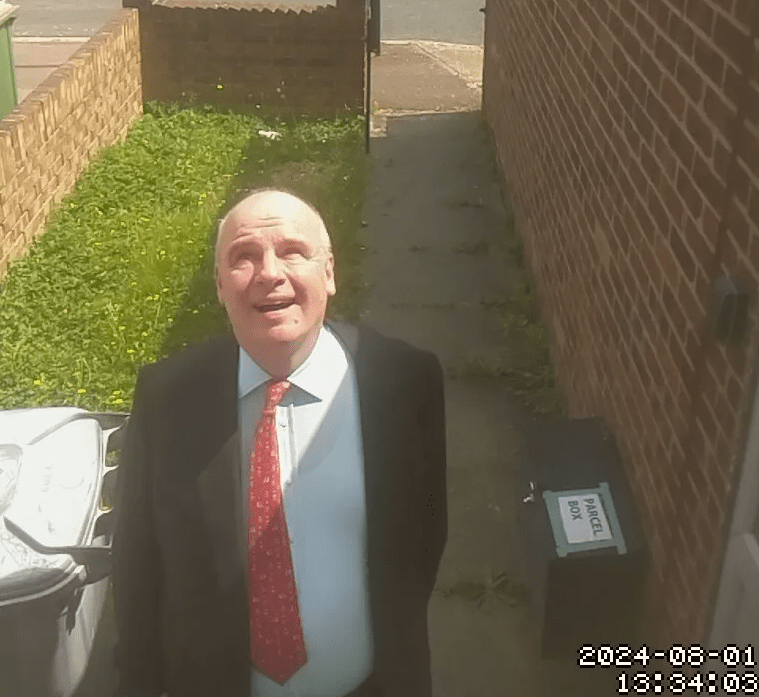
On this visit he posted me a handwritten note. It read variously that “AFTER YOU ARE BANKRUPT IF YOU AGREE TO BE MY TOTAL SEX SLAVE I WILL LET YOU LIVE IN THE GARAGE”
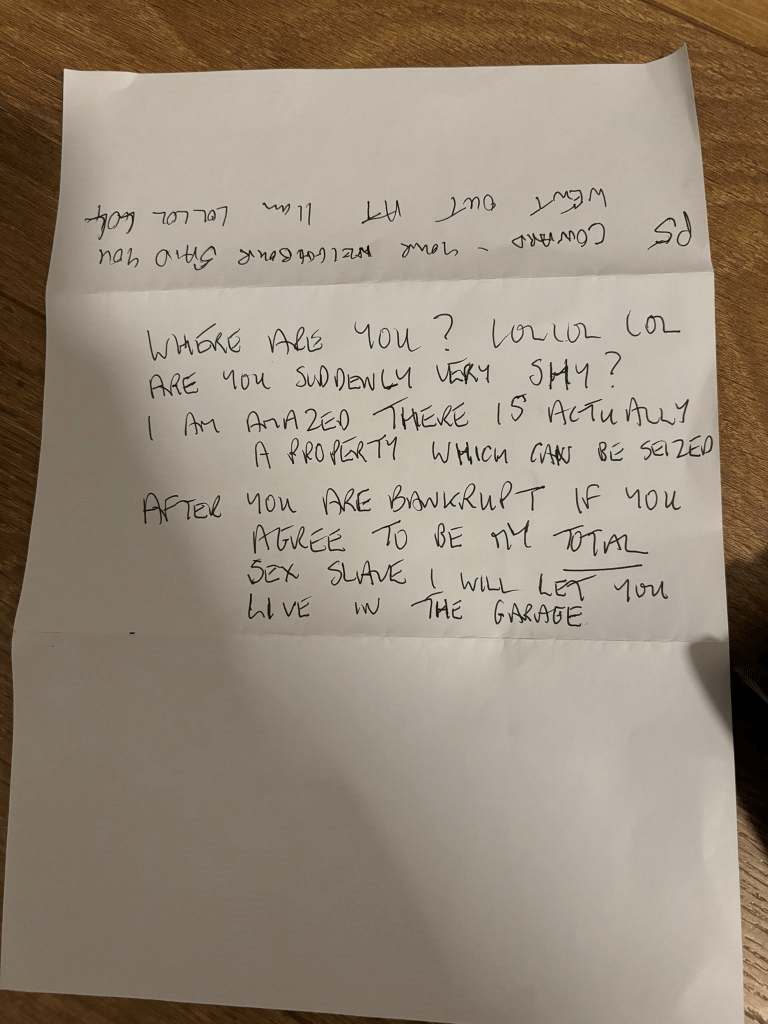
He had warned me he was coming to my house. In a PDF letter attached to an email marked with the legal term without prejudice, he said he was going to pop by for lunch and ‘examine my Mouse Hole properly’.
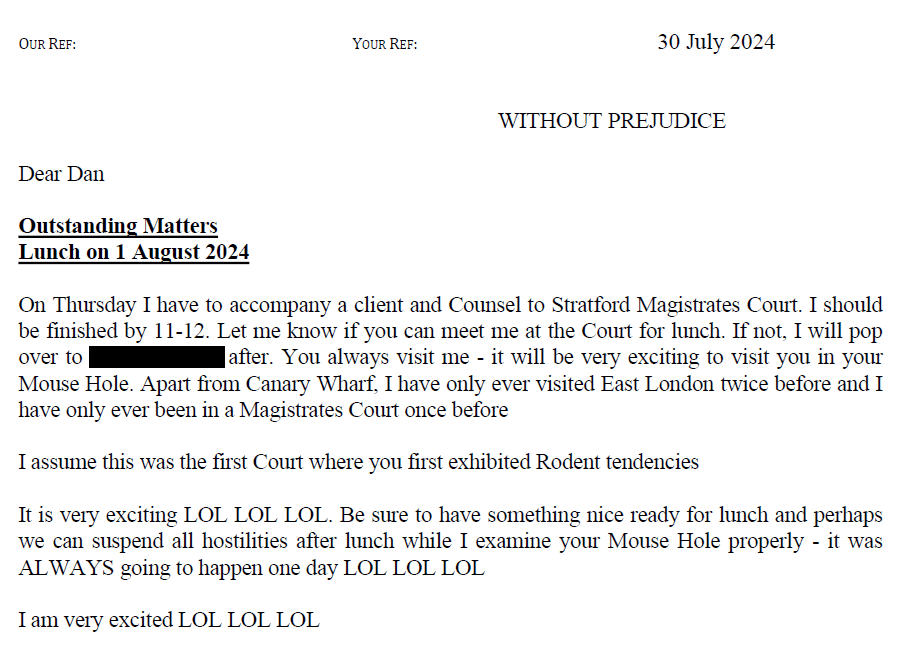
In the same letter he tells me:
I have been assessing my claim against you (which seems to be £100,000-£200,000 for numerous matters
I suggested that a Claims Register be set up of people who want to pursue financial claims against you for compensation and I have been told over 100 have signed up and more than half would be prepared to assign their claims to me for payment by me.I have always known that I was entitled to start High Court proceedings against you for substantial damages and an injunction and costs and also take steps against WordPress which will result in the immediate removal of the website by them.
And he offers to settle with me, quite what exactly I don’t know, and before you ask I’m not sure who Mr Wilson is either:
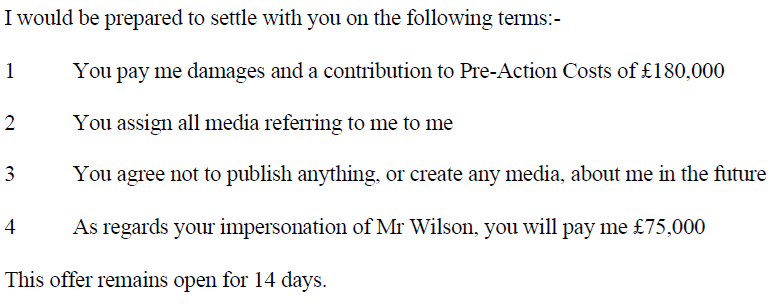
In fact between 11th March 2024 and the date of his arrest on 14th August 2024 Milne contacted me over 120 times. This included emails, physical letters, and a book – along with these voicemails on my birthday.
At a court hearing on 9th January 2025 Milne pleaded not guilty to the offence of stalking.
A 3-day trial is scheduled to begin on January 12th 2026 at Stratford Magistrates’ Court.
Unbolted
In April 2019, this humble blogger replied to an internet forum post explaining how you could pay £10 for a copy of a claim form from the High Court.
Between 2016 and 2018 at least six hundred members of the public used a website called Unbolted to collectively invest in some loans secured against antiques – think of an online-crowdfunded-pawn-shop and you wouldn’t be far wrong.
The amounts lent were fairly minimal. 295 lenders had invested between £4.91 and £99.31, and a further 288 had lent under £980. Only 29 people had lent more.
It was one of the loan investors who was asking how to see details of the claim.
Little did I know how this simple piece of advice would end up exposing one of the most aggressive and prolific litigators in England and Wales – and how I would end up as a target.
Coverage of litigation involving crowdfunded loans, or peer-to-peer lending, is a speciality of this website – indeed, in 2022 The Times described me as ‘an expert on the peer-to-peer industry’.
The Unbolted borrower was Andrew Milne who had launched the claim against the platform. In correspondence to the 600-or-so investors, seen by the mouseinthecourt, Unbolted explained:
His approach is to allege technical deficiencies and threaten costly and time-consuming litigation with a view to obtaining settlement payments from his opponents.
Throughout this process, he has engaged in highly aggressive and defamatory correspondence.
In court filings the directors of Unbolted had said that Milne’s ‘objective is to increase [Unbolted’s] legal costs in an attempt to make these proceedings uneconomical to defend’.
As examples of this conduct the court was referred to letters sent by Mr Milne in which he had:
- Issued a pre-action protocol letter for defamation in 2019.
- Threatened to sue two of the first defendants employees in 2022
- Made criminal accusations against the firm and threatened to issue a private prosecution in 2018.
An extract from one of the letters is shown here:
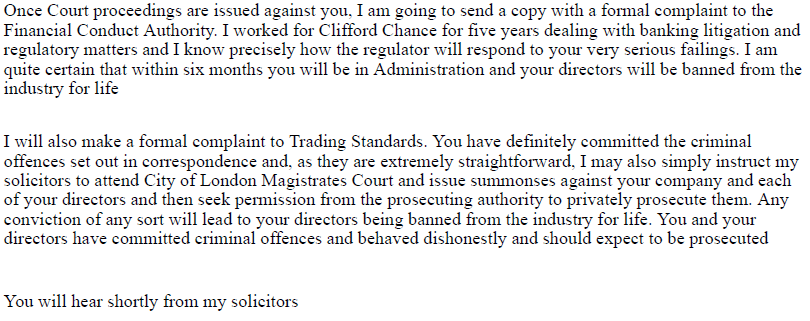
‘My solicitors’, of course, referring to his own firm Andrew Milne & Co.
This concept of ‘highly aggressive’ litigation is one that crops up again and again.
Unbolted may have had in mind this 29-page letter that he had sent to the company. When disclosing this letter to us a legal representative for Unbolted told the mouseinthecourt ‘For the avoidance of doubt, the allegations set out [in the letter] are denied and our client’s position against Mr Milne is reserved to the fullest extent’.
I don’t need to describe the letter – these are the words of High Court judge Mr Justice Fancourt:
[This] is an extraordinary letter running to 29 pages… In it, he threatens to destroy [Unbolted’s] business leaving millions of pounds of liability for its directors, and to pursue large claims against all the individual lenders.
It is in remarkably aggressive and unpleasant terms and shows an apparent desire to wreak havoc on a large scale, so far as [Unbolted] and its directors are concerned, and to put considerable fear into the individual lenders.It would be a concerning letter for anyone to have written, but the Claimant is an experienced practising solicitor in the City of London.
[10+11] Milne v Open Access Finance Ltd & Anor [2020] EWHC 1420 (Ch) (12 March 2020)
Echoing previous comments made by senior procedural judge Chief Master Marsh:
The approach in the letter clearly suggests that Mr Milne’s objective is to create as much difficulty as possible for the defendant, with a view to destroying it. He says so in terms.
Furthermore, he gives clear notice it is his wish that criminal proceedings are brought against the directors and officers of the defendant.
In addition, if that were not enough, he raises the spectre of individual lenders being the subject of proceedings which might lead to their bankruptcy.[15] Milne v Open Access Finance Ltd [2019] EWHC 2517 (Ch) (06 September 2019)
In addition to pursuing a claim against the platform, Milne wanted to join all 612 investors to the claim. He told Unbolted, in his 29-page-letter:
I require the names and addresses and E Mail addresses of every Lender on every contract that I have ever taken out with your company because I am entitled to have that information and also so that the solicitors can send them letters of claim in relation to all the sums due to me.
Milne gives an example of what will happen to a lender only know to him by the cipher 75BE594:
Lender 75BE594 under the contract with me 2DFDC4A5F is a good example.
That lender has subscribed £5.42.
That contract is unenforceable under the Consumer Credit Act…
Lender 75BE594 who is probably a retired civil servant with a nice little house somewhere … is also going to have to incur some very substantial legal fees if he wishes to contest the trial of my claims which will result in him losing his home due to a costs order for over £100,000
As part of my reporting of the Unbolted case I had asked Milne on camera about this ‘aggressive and hectoring’ letter he had sent as he was leaving the High Court in March 2020. Did he really want to make the investors bankrupt?
In the 39-second video he is seen leaving the court building and getting into a waiting taxi. He doesn’t answer any of my questions.
Milne would later go on to allege in a signed witness statement deployed at the High Court that he had ‘nearly died’ in this encounter, in which I had ‘ran at [Milne] shouting threats and abuse’, and which had apparently been orchestrated by the directors of Unbolted.
Even his own barrister stepped back from this claim in court confirming the video ‘doesn’t show that he nearly died’.
You can read our full report on the hearing: Solicitor made “scandalous allegations” of attack by blogger which were “palpably untrue”, court told.
During one of the hearings it was alleged that Milne was conducting this sort of litigation as a business. Unbolted said they had identified at least seven other finance companies who had received similar legal threats from him.
As part of his campaign against Unbolted Milne also asked the Financial Conduct Authority to step in and assess how much compensation he was due from the firm and from some of the investors who had participated in the loans.
When the FCA declined to do so Milne launched a judicial review claim against the FCA at the High Court.
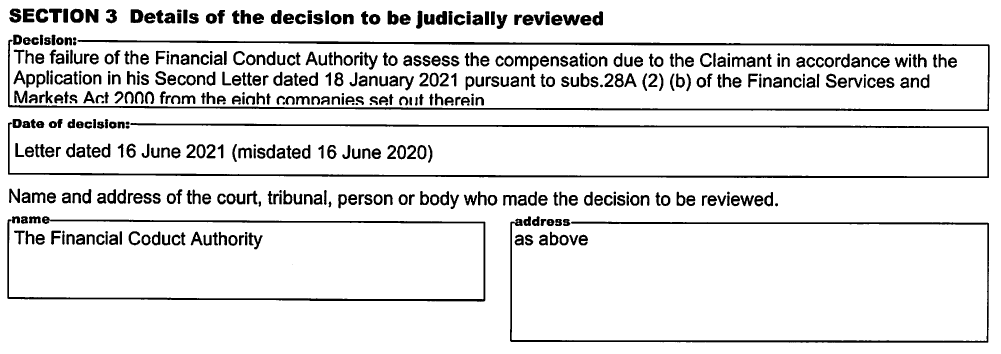
Contesting the entirety of Milne’s claim the FCA said, in pleadings by barrister Iain Steele, there was ‘no arguable claim’ as it ‘would be premature and inappropriate for the FCA to reach its own view on those issues before the Chancery Proceedings have concluded. To do so would create an obvious risk of inconsistent findings by the FCA and the Court’.
Milne also appeared to have misrepresented the ongoing Unbolted litigation to the Authority – by stating that Unbolted had conceded an important point in the litigation, when it hadn’t.
Milne did however receive ‘a £50 ex gratia payment’ from the FCA ‘purely for the administrative delay in handling’ his complaints. A request to judicially review the size of this amount was ‘also misconceived’, the court papers stated.
In 2024 procedural judge Master Brightwell also made disparaging remarks about Milne’s correspondence with Unbolted:
Correspondence from 2019 … undoubtedly shows an aggressive and antagonistic form of communication
I consider that a good part of [Milne’s] correspondence and evidence is written in a tone which has the, no doubt intended, effect of causing antagonism
[Milne] comes across as obfuscatory, tendentious and facetious
[58+14+62] Milne v Open Access Finance Ltd & Anor [2024] EWHC 671 (Ch) (23 February 2024)
Part of this judgment concerns exactly where Milne was said to be living. One property in particular was discussed in detail …
The Mansion – The Tenant
The Mansion (with single ball room with triple ceiling height) refers to a property in North Wales purchased by Milne for £80,000 in September 2016.
It was leased to a pre-existing tenant upon Milne’s acquisition of it.
Upon termination of the lease, in November 2016, Milne says it was apparently discovered that ‘the courtyard, ground, first, second and third floors were full of in excess of 20 tonnes of rubbish including, but not limited to: (a) abandoned soft toys and clothes…’.
Particulars of claim drafted by barrister James Hanham were filed at the High Court by Milne against the former tenant in November 2021 – who it was said owed £3,580 in unpaid rent and a staggering £288,800 to rectify problems listed in a so-called schedule of dilapidations. Costs and interest were also claimed for.
The Mansion – The Finance Provider
The nightmare for Milne at the Mansion did not end there as he also launched legal proceedings against West One Loan Limited, a self-styled provider of specialist mortgages and property finance, who had financed the purchase.
Legal filings show that a claim was launched at the County Court in August 2019.
The claim, that following an alleged breach of the Consumer Credit Act Milne should be able to keep the loan without having to repay it or the interest, along with payment of his legal costs, ended up before a judge in May 2020 for a procedural hearing.
His Honour Judge Saunders said he was shocked at the ‘extraordinary amount of money’ which comprised the ‘wholly disproportionate’ costs proposed by Milne which were circa £1.45m – the phrase ‘wholly disproportionate’ actually appearing in the court order.
The court reduced his £1.45m anticipated costs by 96.9%.
The value of the claim was only £20k.
Milne threatened to apply for a so-called Group Litigation Order (often known by the American term class-action) if West One didn’t settle.
The barrister representing West One Loans told the court that as Milne had instructed his own firm to represent him that this allowed him the ‘unhindered ability to claim costs’ under a ‘grossly inflated’ budget.
Milne had to pay 33% of the costs of that hearing due to ‘unreasonable behaviour’.
The Mansion – The Finance Provider settlement costs
West One Loans offered to settle the case with Milne, or as their barrister put it ‘attempt to scotch matters in the most cost-effective way forward’.
In a hearing at the High Court Milne said he accepted the offer of a settlement but ‘was horrified to receive the bill that is before [the court] today’.
Mr Smith, representing West One, described Milne’s allegations, if he could ‘encapsulate in one word, well two words, as fraud and dishonesty’ as ‘somewhat fantastical’.
Mr Smith criticised Milne’s conduct in the litigation and ‘the vigour by which the claimant pursued the litigation’. Mr Smith referred to the ‘flavour’ of language used in the correspondence adding ‘all of that is hard work to respond to’.
This site reported on the costs hearing in Solicitor blocked from conducting “a classic fishing expedition”, costs judge rules.
The Property Tribunal
Making claims of fraud is a common theme for Milne. In litigation against the freeholder of his flat in South Kensington the leasehold valuation tribunal was critical of his overall approach in the claim.
The tribunal ‘broadly agreed’ with the landlord’s criticisms which included:
9c. The making of very serious allegations (green, laziness, asset stripping, fraud, etc.) without any real evidence in support.
9d. The applicants attempts to enlarge and expand the proceedings by unnecessarily attempting to get the hearing time extended to 2-3 days for no good reason and to get the tribunal to inspect the interior of the building in question when the application did not concern the interior
9e. The failure to consult with [the freeholder] over the hearing bundle and the failure to include relevant documents in the bundles so that the Respondent had to produce further bundles
9f. The filing of a very long witness statement, much of which was irrelevant
And found ‘that such conduct…’:
(A) can be properly described as unreasonable, frivolous or vexatious, and;
(B) caused the Respondent to incur much greater costs in opposing the application than it should have incurred (that is many hours of legal work the value of which will easily exceed £500)
Commentary about Milne continued:
[Milne’s] application contained much irrelevant detail and also contained some rather wild and ultimately unsupported allegations of asset-stripping, greed, laziness, deliberate poor management and fraud.
Examples of [Milne’s] unreasonable behaviour in connection with the proceedings can be taken from a statement attached to the original application. Serious allegations (ultimately unsubstantiated) were set out in the application as follows;
Since their purchase of the freeholds in South Kensington approx 15 years ago the respondents has made vast capital profits but has been both extremely greedy and extremely lazy and has never made proper arrangements for management which is what has given rise to this application. The respondent has simply been an asset stripper in the very worse possible sense
The Respondent has made vast profits from the increase in capital values of their South Kensington estate and their overcharging of leaseholders by millions of pounds….
The rest of the statement contained unnecessary details of the parties previous dealings and of the many unsubstantiated allegations as per the examples given above.
Later in the proceedings the applicant filed a witness statement the part of that statement dealing with the service charge application ran to 30 pages, much of it ultimately irrelevant.
An example of this can be seen from paragraphs 112 to 132 under the heading ‘housekeeper’. These paragraphs all concerned a housekeeper at the property in question, all of them irrelevant. The tone of much of the applicant’s evidence and submissions is demonstrated in this part of a witness statement of paragraph 121 of this statement where the applicant states:
I would give an example of an incident which shows how lazy and malicious Ms Boyd the housekeeper is….
The paragraph goes on to relate an incident with Ms Boyd and other occupiers which is completely unconnected to the issues in the application
[Milne] is a sophisticated litigant. He is a solicitor and runs his own firm. He has litigated against the respondent previously.
The applicant could therefore be properly be expected to make and pursue an application that
(a) contained only reasonable relevant allegations and evidence
(b) avoided making allegations but were not ultimately supported with any evidence
(c) he was able and willing to properly prepare the hearing bundles for, bearing in mind that given the number of allegations he made he could expect the response to put in large amounts of written material in response.
The tribunal has no doubt that the applicant made very serious allegations against the respondent that he did not support, that his application failed to make clear the limited scope of works and costs but were being challenged and that his application contained much irrelevant detail that ultimately wasted everyone’s time.
[Milne] is in a position to know better and accordingly his conduct, as described, can be properly be described as unreasonable, frivolous and vexatious. The result of this was undoubtedly that the respondent was put to far more work than it should have been in dealing with this application.
The tribunal has no doubt that the additional work would have been many hours and the value of that work far exceeds £500
At the time, five hundred pounds was the cap of any costs that could be claimed at the tribunal.
Private prosecution #1
This concept of aggressive litigation has continued from the civil courts, where Milne ostensibly has his career as a solicitor, into the criminal.
A private prosecution brought by Milne, which ended up at the Crown Court sitting in Mold, was made against three individuals.
At a hearing on 22nd December 2023 Ms Cooper, the barrister representing the three defendants, told His Honour Judge Niclas Parry that ‘the Defence will be inviting the Crown Prosecution Service to review this matter, take it over, and discontinue it’.
She submitted that ‘one of the features of this case and a feature that will be pointed out to the CPS is that it’s felt that Mr Milne is pursuing this as essentially part of a personal vendetta’.
The perverse situation that has been created is revealed by her next submission: ‘Your Honour is asking that I send our submissions to the private prosecutor, the private prosecutor is Mr Milne. He operates from a solicitor’s firm where he is the only solicitor, he is the one writing all of the legal correspondence, he is also the complainant and the main witness’.
Ms Cooper continues:
‘I would ask that we aren’t asked to disclose [our witness statements] at this point to the private prosecutor … Because obviously we would essentially be sending all of this material to the main witness in the case before we even had his witness statement’.
‘I understand’, replied the judge.
Private prosecution #2
We can also reveal the existence of a second private prosecution at Southwark Crown Court against two individuals and a company.
The CPS told the court in October 2025 that they had taken the case ‘over, and we have obtained counsel’s advice on the merits of a prosecution and the advice has been that there is not a realistic prospect of a conviction against all three defendants’.
The charge, one of fraud, is that a storage and removal company ‘X and Y Ltd’ seemingly incorrectly invoiced Milne using the company name ‘X and Y Group Ltd’.
The particulars of the offence are that between 25 November 2020 and 1 August 2023, [X and Y] Group Ltd dishonestly made false representations, thereby with the intention to make a gain for itself; namely, by sending statements and invoices for the purposes of receiving payment from Mr Andrew Milne, a customer of [X and Y] Ltd, such that Mr Andrew Milne was misled into believing that such payments demanded by [X and Y] Group Ltd were in fact demanded by [X and Y] Ltd.
Running in parallel with these criminal proceedings were civil proceedings filed against the same parties at the County Court.
Sainsbury’s
On June 24th 2022 Milne was in a Sainsbury’s store in Prenton.
After paying for four items, understood to be ‘four bottles of Oral Rinse mouthwash, each costing £6’, Milne says that whilst en route to his car he heard a man shouting at him. The man ‘was clearly an official security guard employed by Sainsbury’s’ and apparently shouted the following words which slandered Milne:
Stop thief
You are a thief.
You are a shoplifter.
You should be in jail.
I am arresting you for shoplifting.
You are a thief . . . you are stealing my bag . . . you have stolen goods in your
bag.
I am arresting you, thief.
It was claimed that ‘the words complained of meant and were understood to mean that the Claimant is a thief, a shoplifter’ which had ‘imputed that the Claimant had committed a criminal offence’.
Milne launched a £25k defamation claim against the supermarket at the High Court.
In their legal pleadings Sainsbury’s said ‘the claim is bound to fail and/or is “not worth the candle”, in that the costs and court time required by this litigation are likely to be disproportionate to the minimal, if any, vindication obtained’.
At a costs and case management hearing held before procedural judge Master Brown, on 14th March 2024, written submissions filed on behalf of Sainsbury’s criticised Milne’s ‘grossly disproportionate’ and ‘unreasonable’ costs budget.
The court was told it was ‘unreasonable and excessive’ for Milne to complete the work as a so-called grade A fee earner, charging between £398 and £546 per hour.
As the proprietor of his own law firm, Milne is able to re-charge work through ‘Andrew Milne & Co’, rather than the then litigant-in-person rate of £19/hour.
During a 17-minute-hearing we were told that the parties had in fact agreed a costs budget between themselves of £100,890.50 each. That’s equivalent to 16,815 bottles of Oral Rinse mouthwash.
The case settled following mediation between the parties and none of the claims were tested in court.
Glenavon
Legal papers filed at the County Court in August 2021 detail how Milne became the owner of a house on Glenavon Road, Prenton after ‘effectively inheriting [it] from his parents, who had lived there for many years’.
Milne claimed damages of £500 and £300 per month from the owner of the house immediately next door because they had apparently ‘failed to maintain the fences dividing the rear garden’ and ‘front garden’ respectively; damages for ‘trespass’ of £300/month because ‘The Defendant’s rear fence encloses some land which belongs to [Milne]’; and damages for nuisance and trespass totalling £500/month because ‘The Defendant has allowed plants to grow from his garden over the dividing line’.
The sad element to this litigation is that the defendant home owner is understood to have been incapacitated and in a care home at the time of the legal dispute.
Milne ended up buying his neighbour’s property for £215k, significantly lower than the £280k it had been marketed for.
Hyde
The land shown here in red, in Hyde Manchester, was bought by Milne at auction for £2,250 in October 2020.
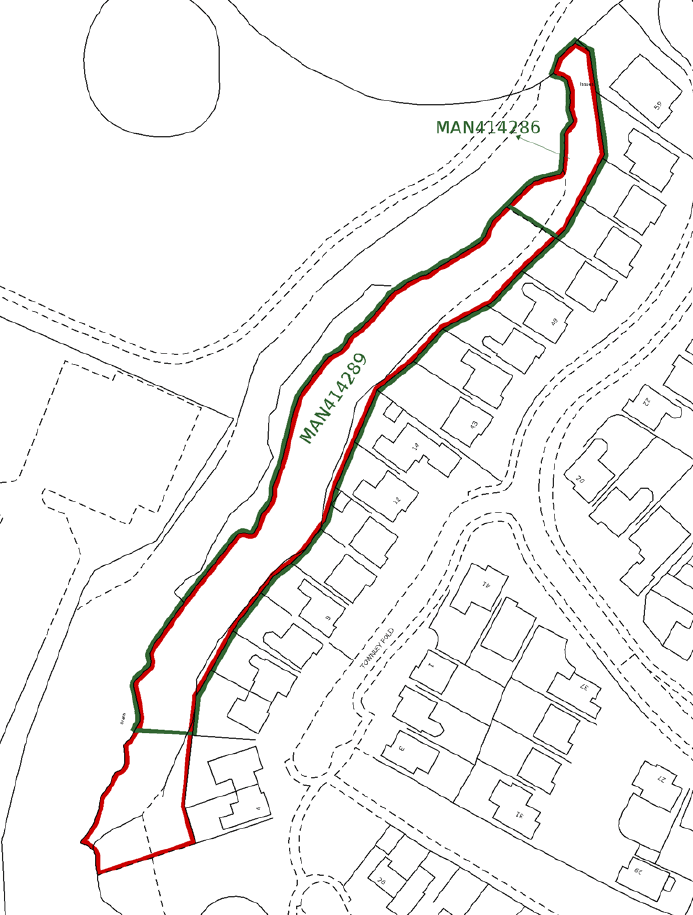
The mouseinthecourt attended a High Court hearing resulting from a claim against just one of the neighbouring properties. Milne had apparently discovered ’50 tonnes or more of loose earth … [were] collapsing onto [his] property’.
It was said in written pleadings by Milne that the ‘correct remedy…is to remove the rear garden and then underpin to a depth of at least 60 feet’.
This was described in court by Sam Keeling-Roberts, on behalf of the Hyde defendant, as a ‘very expensive remedy against the defendants, and could well be construed as an attempt to bully the defendants and neighbours’. This assertion was ‘soundly rejected’ by barrister Camilla Chorfi, on behalf of Milne.
Legal threats were made against further neighbours. Parcels of Milne’s land were sold off to them, presumably to quash and settle any claims, for a combined total of £200k.
An 8,788% return on his original investment was obtained by Milne.
Slaithwaite
We see the beginnings of this script playing out again in Huddersfield this year, although the situation is reversed – Milne’s land is now at the higher level and is apparently failing to receive support from the land below.
‘The land purchased by [Milne] runs in front of and to the rear of a row of 30 properties’, says the legal response to a claim filed at the High Court. His land is shown in green here:
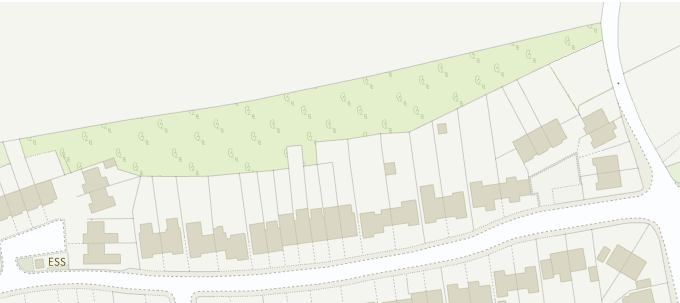
Milne had bought the land on 20th March 2025. The first high court claim against a resident of a neighbouring property is dated 19th May 2025.
That’s 60 days between completion and the thud of legal documents on the doormat.
David Price Solicitors and Advocates
Barristers engaged by the firm Andrew Milne & Co have also become embroiled in litigation over fees.
In 2005, Milne instructed David Price Solicitors and Advocates following a settlement with The Telegraph Group in libel proceedings. The agreement between them was subject to a so-called conditional fee agreement.
The agreement was disputed and ended up in court. What is key to note are comments made in the judgment of Costs Judge Seager Berry about Milne’s conduct:
[Milne] then embarked upon a course of correspondence which I can only describe as inappropriate and wholly disproportionate to the issue between them. His correspondence with the Office for the Supervision of Solicitors was unnecessary. After extensive correspondence in which [Milne] maintained his combative stance the Defendants submitted their bill to him…
…
His evidence was in many respects unsatisfactory. He was evasive on many issues
…
[Milne] has either mis-recollected the point or deliberately chosen a later date which suits his convenience.
…
[The firm’s] letter to the [Milne] dated 12 February 2003 was friendly and reflected what he understood to have been agreed. The response was entirely different. There were references to “I am astonished”, “I am disgusted”, “your disgraceful behaviour leaves me with no alternative but to dismiss you as my solicitors”.
…
[Milne’s] response dated 19 February 2002 was described by Mr Rushbrooke as unacceptable if it came from any litigant let alone a solicitor and an officer of the court and as utterly deplorable. It reflected views persisted in during the hearing and contained in the Claimant’s witness statement, examples were:
There was an unsustainable allegation that Mr Duodu had quoted costs…
ii) There was a reckless allegation of misrepresentation that Mr Duodu was an expert in defamation costs.
iii) There was the disgraceful allegation that Mr Duodu had refused to attend the detailed assessment hearing.
…
The Claimant has considerable experience in litigation. I have been able to observe him giving evidence. He made allegations to advance his case which were at times bereft of substance.
Barristers X + Y
In 2022 Barrister X filed a claim against Milne for an alleged non-payment of fees following work in 2018. Some £4,257 was sought, to include interest and costs.
In Milne’s Defence he explains that he ‘contracted with [Barrister X] on behalf of an overseas lay client on the express agreement that he would have no personal liability for fees’.
The allegations followed thick and fast:
‘The services provided by [Barrister X] were of no value. He was extremely pompous and sounded as though he was drunk when [Milne] sought advice from him. [Barrister X] was professionally negligent and all his advice was wrong and of no value’.
The complaints procedure was used, twice, but Milne says he was ‘completely ignored’. When Milne apparently ‘telephoned [Chambers] to follow it up staff repeatedly swore at him and slammed the telephone down’.
In May the following year a claim was personally filed against Barrister Y KC, also of the same Chambers, with the solicitor demanding £9,000 for apparent fraudulent misrepresentation.
The legal filings seen by mouseinthecourt reveal that Barrister Y KC was nominated to ‘deal with complaints made by [Milne]’. Complaint number 7 apparently recorded that the solicitor asked for details of the GDPR data controller of the Chambers – with Barrister X replying that the chambers was itself its own data controller.
The legal filings state:
This was a lie. [Barrister Y] was guilty of misrepresentation and also fraud because he must have known that his reply was a lie and so [Milne] also claims for fraudulent misrepresentation…
[Milne] spent a considerable amount of time researching the position to discover that the defendant had lied to him and was guilty of misrepresentation. The claimant claims damages, including for time spent, of £9,000.
Barrister Z
In another claim, dated February 2024, this time brought by Barrister Z KC, of another set of Chambers, it is alleged that Milne had £26,000 of outstanding fees, plus at least £6k of interest.
In a Defence filed at court, Milne says Barrister Z ‘never provided [him] with any contractual terms and none have been agreed’.
Notwithstanding that ‘it was agreed at the outset that [Milne] would just use his endeavours to collect the Claimant’s fees from his client [x], who is a foreign national based overseas above the age of retirement and [Milne] would have no personal liability’.
It was said by Milne that the ‘clerks had previously completely ignored [him] and any alleged outstanding fees, as soon as [Milne] started paying, they became hysterical and threatened to sue [him]’.
Again the accusation fly thick and fast. Milne claims his barristers ‘behaviour in relation to fees was completely shambolic in every respect’ and he was ‘professionally negligent’.
Mrs Mainwaring
One of the earliest cases involving Milne, for which public records are still available, is from 1999.
In September 1996 Milne says he was removed from a ‘committee of an unincorporated association known as the Smith Charity Leaseholders Group’.
He sued seven people who were members of the committee, with a writ dated 24th September 1997. ‘He alleges that his removal was unlawful and he claims in the action 12 grounds of relief’ says a judgment at the Court of Appeal.
Four of the seven sought to have a Mrs Mainwaring represent them at a preliminary hearing and at trial. She was described as being ‘intelligent and articulate’ but had ‘no legal qualifications, nor training’.
The judge hearing a preliminary hearing allowed her to represent the defendants despite Milne’s objections. Normally, only qualified lawyers, such as barristers, have so-called rights of audience, meaning the legal right to appear and speak on behalf of someone in a court.
Three senior judges heard the appeal by Milne, described by Lord Justice Aldous as ‘somewhat academic’ given Mrs Mainwaring accepted she would not represent the defendants at trial. The appeal was pursued nonetheless.
The judgment records the submissions of the fifth defendant:
She submitted that the judge was right to allow Mrs Mainwaring to represent the four defendants and that there were exceptional circumstances in this case.
She submitted that the whole case was a harassing one.
She described the tactics used by the plaintiff as Mafia tactics.
The plaintiff, a solicitor, had, she submitted, conducted the case, which was for a small amount of money, in such a way that the defendants had had to incur substantial costs.
The position had been reached when they could no longer go on paying their lawyers as there was no chance of an order for costs being made in the defendants’ favour being paid by the plaintiff.
She believes that the plaintiff has behaved disgracefully, not only in the conduct of the action but in the whole action.
The submissions of the seventh defendant were also summarised:
The fact that the appeal was being pressed was, in his view, another instance of the way the plaintiff had harassed him and his co-defendants in the litigation.
Second, he drew attention to the substance of the action which he described as trivial or “a parish pump” dispute. Even so, according to him, the case had developed into a vendetta by the plaintiff, with the result that the costs had escalated out of all proportion to the costs of the dispute.
It would therefore be unjust and contrary to natural justice to require the defendants to pay more money to obtain legal representation to match the ability of the plaintiff. The plaintiff used his firm, whereas the defendants would have to pay a firm of solicitors and counsel.
…
He said that it was a breach of common sense that a dispute in a committee of unincorporated local residents, combined with a dispute over expenses amounting to just over £2,000, and a solicitor’s bill of £500, should lead to costs amounting in excess of £100,000.
He said that it was unfair and a breach of natural justice that in such a minor dispute a party should be open to the imposition of costs far outweighing the value of the action.
Third, it was unfair and also a breach of natural justice that the actual direct costs of one side were significantly lower than those of the other. In that respect he was referring to the fact that Mr. Milne was a solicitor and therefore could use his firm to carry on the proceedings, whereas they would have to employ solicitors and counsel.
No findings of fact were made by the court on these submissions although Lord Justice Waller said ‘It seems to me that a party such as Mr. Milne’s interest in whether one lay person should represent all others is only minimal. I am anxious that an appeal has been brought in this litigation. I am anxious that it may have been brought for tactical reasons and not because of any real concern as to whether Mrs Mainwaring should represent all four defendants’.
Auction Houses
We have seen two County Court claims that are so similar we have grouped them together.
Two separate auction houses launched separate claims against Milne for allegedly not paying for items following an auction.
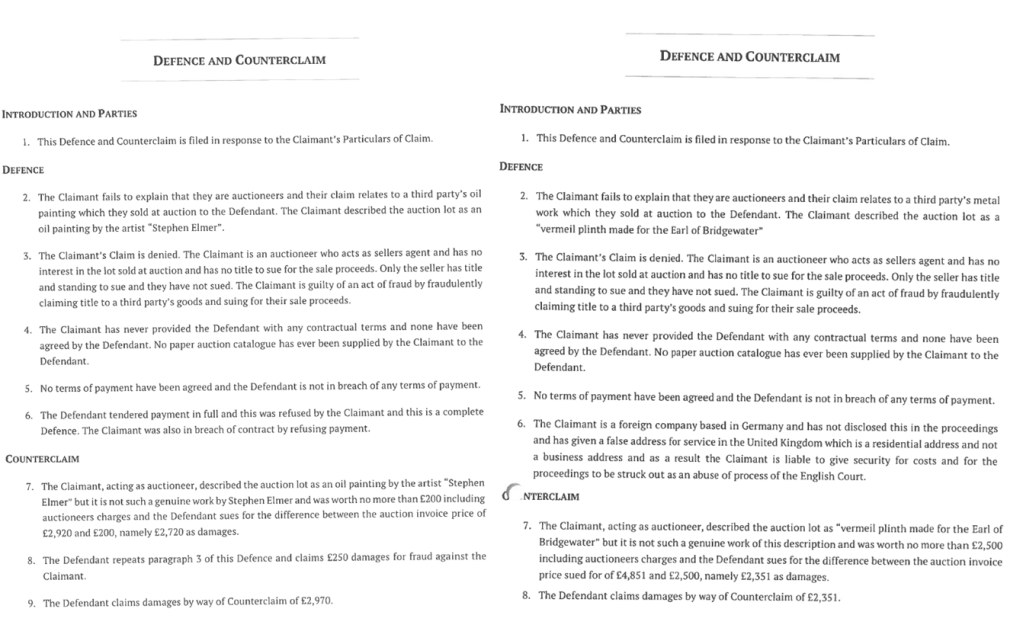
Milne’s Defence in the first claim, dated May 2024, responds to claims that Milne had failed to pay for an ‘oil painting by the artist Stephen Elmer’, and is notable for a counterclaim of £2,970 because the item is apparently ‘not such a genuine piece’.
Milne’s Defence in the second claim, dated October 2024, responds to claims that Milne had failed to pay for a ‘vermeil plinth made for the Earl of Bridgewater’, and is also notable for a counterclaim of £2,351 because the item is apparently ‘not such a genuine piece’.
We have put his two Defences side by side below. Spot the difference.
Note the accusation that the auction house ‘is guilty of an act of fraud by fraudulently claiming title to a third party’s goods and suing for their sale proceeds’.
Crown House
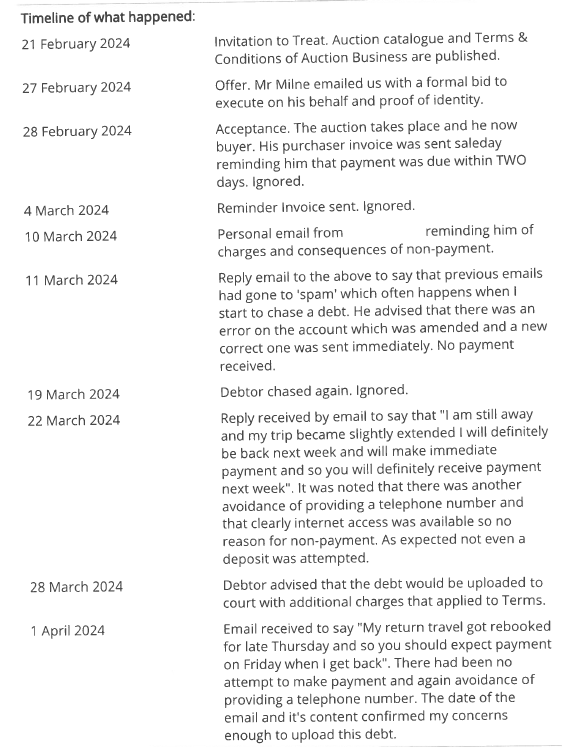
Milne bought the freehold of a building called Crown House at auction, completing in July 2022, for £40,000.
Within 8 weeks Milne commenced a claim at the County Court against a single resident demanding £66,100 for alleged arrears of the service charge. A resulting judgment, in a subsequent claim, records Milne stating ‘that he believed that, if [the resident] paid up, the other tenants would do so as well’.
In response to Milne’s demand the tenants issued their own claim against Milne alleging he hadn’t offered them a right of first refusal to the existing leaseholders when he bought the freehold.
Accordingly, it was claimed, the tenants are ‘entitled to compel sale by [Mr Milne] to the tenants’.
The claim was successful with Milne ordered to sell the property for the price he paid, £40k, plus auction fees, to the leaseholders.
This litigation was notable for the scathing remarks by the judge about Milne’s conduct.
His Honour Judge Keyser KC said of Milne: ‘I do not consider him to be an honest or credible man … For his own ends, he is willing to resort to intimidatory and threatening language, advancing allegations that he cannot possibly believe to be justified’.
As to whether he could be trusted the Judge remarked ‘on a contested issue on which [Milne’s] interests turn, I should be reluctant to accept his evidence unless it were supported by documentary or other evidence’.
The judge also took the unprecedented step of reporting Milne ‘to the Solicitors Regulation Authority for consideration and, if appropriate, investigation’ after sending a counter-notice, the terms of which ‘would, to say the least, have been inappropriate coming from anyone. Coming from a practising solicitor, they are disgraceful and inexcusable’.
Quotes from this counter-notice, described by HHJ Keyser KC as ‘a remarkable, 11-page document, to which mere paraphrase or selected passages cannot do justice’, were set out in the judgment:
…you [the solicitors acting for the tenants] have acted both maliciously and dishonestly in serving [your claim].
I formally accuse you and your four customers of fraud.
I claim damages for fraud for the costs of investigation of your Notice dated 5 December 2022 and the preparation and service of this Counter Notice.
I have also ceased to progress various matters at Crown House and claim damages of £10,000 a month from your company and each of your four customers from 5 December 2022.
You should take this as a formal Claim against you and I require the name and address of your professional indemnity insurers by return and your policy number.
Please agree to pay me damages by 5pm on 31 January 2023 failing which Court proceedings will be issued against you and your four customers without any further notice.
Another quote directed at the solicitor acting for the tenants reads:
Your gross professional misconduct is above the evidential threshold for prosecution before the Solicitors Disciplinary Tribunal. … An expert has examined all the documents and has identified 37 separate charges to make against you.
The expert has recently dealt successfully with one of the largest cases to ever be referred to the Solicitors Disciplinary Tribunal.
Virtually 100% of prosecutions are successful. Your misconduct is particularly blatant and persistent.
I require you to show cause by 5 pm on 31 January 2023 why I should not make Application to the Solicitors Disciplinary Tribunal against your Company […] without any further notice or warning.
The judge noted that ‘as [Milne] refused to identify the expert, I suppose it is possible that he is purporting to be his own expert’.
You can read our write-up of the case here – Solicitor sent “disgraceful and inexcusable” communications in £40k property dispute, court finds.
The SRA
Many people spoken to by the mouseinthecourt say they have reported their concerns to the Solicitors Regulation Authority, as did a circuit judge in January 2024.
Our purpose is to protect the public by ensuring that solicitors meet high standards, and by acting when risks are identified
SRA’s ‘How We Work’ https://www.sra.org.uk/sra/how-we-work/
We can exclusively report that Milne ‘has been under investigation by the [SRA] since 2018 due to reports of professional misconduct’.
This quote came from legal submissions dated February 2021, written by law firm Capsticks Solicitors, on behalf of the SRA.
Examples of the alleged misconduct were included in the SRA’s legal submissions:
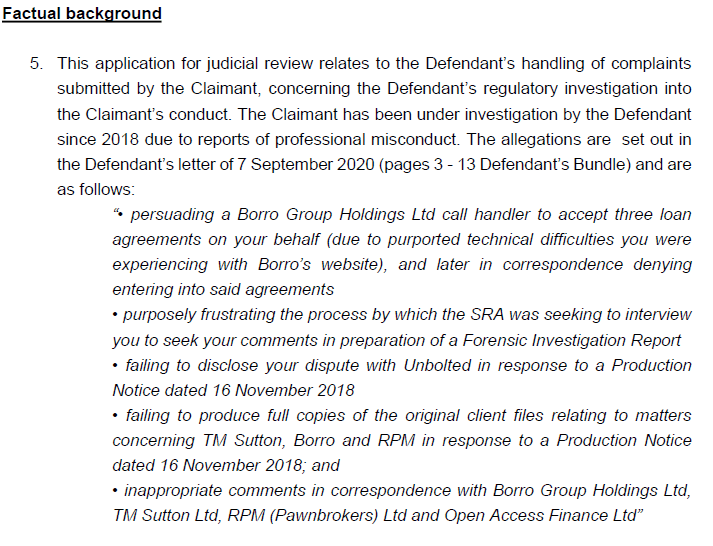
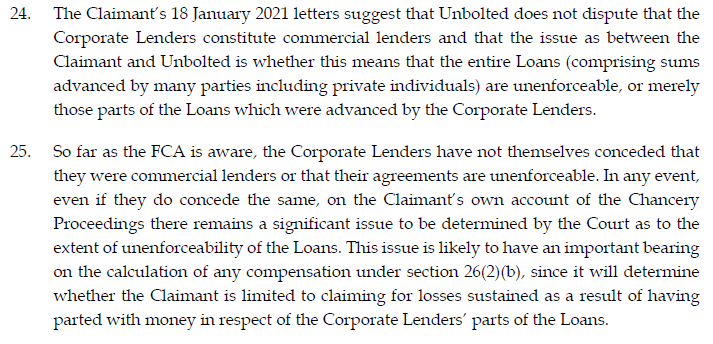
The first bullet point listed, effectively an accusation of fraud, is a serious claim – especially when Milne stated he ‘obtained a settlement of about £600,000’ in the resulting litigation against Borro.
The cases mentioned in the last bullet point, in which inappropriate comments were alleged to have been made, generated ‘over £1 million’ in settlement payments, Milne claimed.
The First Judicial Review
‘Judicial review is a type of court proceeding in which a judge reviews the lawfulness of a decision or action made by a public body’ says official sources.
This is the front page of the first claim against the SRA:
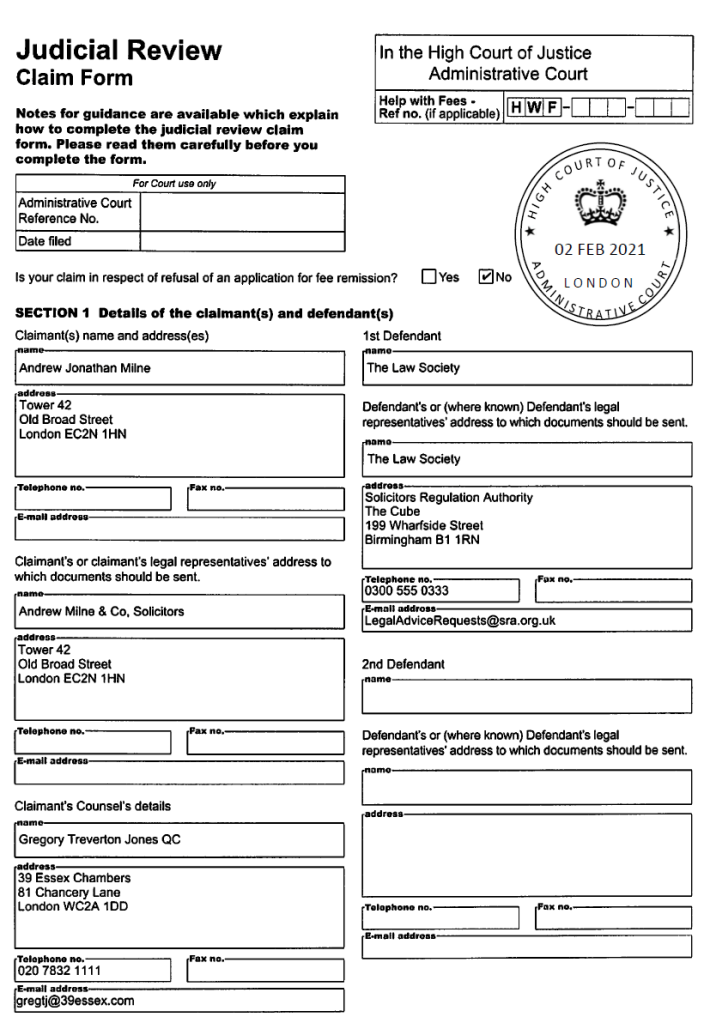
Complaints
The substance of the judicial review is a contention that the regulator should not take any action until Milne’s complaints about the regulator have been replied to.
The first complaint made against the regulator, by Milne, was said to have been on 27th August 2019, and was replied to by the SRA some 5-weeks-later.
What followed was described as ‘substantial correspondence’ as ‘between 24 January 2020 and 11 June 2020, [Milne] made a further 103 complaints’ with the issues ‘raised overlapping with the regulatory issues the [SRA] was currently investigating’.
These 103 complaints were sent over a period of 96 working days.
As you would expect from a regulator tasked with protecting the public they told the solicitor they ‘would defer consideration of [their] complaints until after the SRA’s regulatory process was concluded’.
In August 2020 Milne responded by requesting an Independent Review and sent a pre-action letter for judicial review ‘requesting the SRA to not take regulatory action until it had dealt with [his] complaints’.
On 7th September 2020 the regulator refused this request having provided what was described as ‘detailed reasoning for its decision’.
On 16th October 2020 the solicitor was told ‘that his actions amounted to unreasonable conduct’ and was warned that ‘contact restrictions would be imposed in line with [the Unreasonable Behaviour Policy] if he continued to behave in this way’.
This didn’t work as ‘despite this, [Milne] continued to send repetitive complaints whilst aware that his concerns were in the process of being considered’.
By 20th October 2020 the number of complaints sent by the solicitor was said to have reached at least 153.
This number was contained within a response containing comments made by the Independent Reviewer which found that the SRA had ‘appropriately dealt with your concerns’ and that the ‘decision to defer your concerns … was fair and reasonable’.
On the same day Oliver Sweeney, then Head of Legal and Enforcement at the SRA, wrote to the solicitor saying that he ‘had continued to send repetitious complaints with unreasonable deadlines’ and issued a so-called contact restriction against them.
We will decline to respond to further correspondence which does not raise new issues. Such correspondence will be read and filed but we will not acknowledge your correspondence, unless you provide significant new information or evidence relating to the matter.
If the issue you raise appears to relate to a matter which is currently awaiting a response from us, we will not acknowledge or answer any such correspondence.
Terms of the SRA contact restriction
Mr Sweeney stated ‘If you do not refrain from engaging in such correspondence, it may be proportionate in due course to block all your emails due to their number and length’.
Milne was told he had ten-working-days to appeal the restriction… which he did on November 2nd 2020.
On 18th January 2021 Milne sent another pre-action letter for judicial review ‘in which [he] alleged a failure to respond to [his] complaints by 18 December 2020 in accordance with [The SRA’s] complaints procedure, and a failure to process [his] appeal against contact restrictions’.
On 1st February 2021 the SRA responded to the letter of claim saying that ‘due to the large volume of complaints … further time was needed’ and that a response would be sent on 5th February 2021.
The SRA say Milne’s decision to then formally issue proceedings at the High Court on 1st February 2021 was ‘premature’ adding that ‘had [Milne] properly waited for the [SRA’s] response [4-days later], it would not have been necessary to issue these proceedings’.
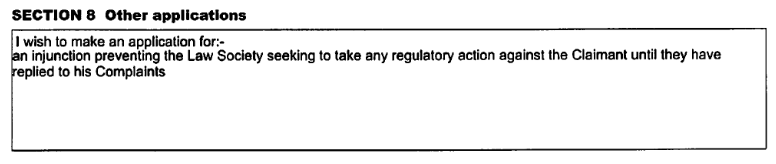
The claim form contains an extraordinary request:

In any event the SRA did reply to Milne on 5th February 2021 with Rachel Pillinger, Head of Corporate Complaints, finding ‘that the decision to impose contact restrictions was in line with the [SRA’s] Unreasonable Behaviour Policy and was necessary to enable [them] to continue to provide an appropriate service’.
Ms Pillinger noted that Milne ‘sent frequent, often weekly, lengthy and repetitive letters, many of which contained unsubstantiated allegations and unreasonable timescales’.
This was said to have ‘negatively affected’ the regulators ability ‘to carry out its work generally, but also affected its ability to carry out its regulatory investigation in the public interest’.
At this point the number of complaints had reached 184 – equivalent to one complaint every other working day.
Ms Pillinger said ‘that many of these were not complaints but simply uncorroborated false statements or unreasonable requests (such as [Milne’s] request that he be nominated for an excellence award), and so would not be responded to’.
Having grouped his complaints ‘into three broad categories (delay in the investigation, bias/discrimination, and failure to respond to complaints)’ Ms Pillinger said she had found ‘No evidence of bias or discrimination’ but that ‘there had been a level of delay in progressing its regulatory investigation (due in part to the volume of correspondence)’.
Milne was told he would receive an update by 22 March 2021.
Ms Pillinger confirmed ‘that correspondence would not be acknowledged or responded to in the meantime in order to prevent further delay to the investigation’.
In response to the judicial review claim asking for an injunction preventing the regulator taking action until all 184 complaints had been resolved the SRA said this application ‘should be marked as totally without merit’ as Milne ‘has put forward no arguable grounds for judicial review’ and ‘the subject of this claim are not susceptible to judicial review’.
The SRA also submitted that this claim was ‘an abuse of the Court’s process’.
…although the claim purports to be a challenge to the SRA’s handling of the Solicitor’s complaints, it is actually an improper attempt to frustrate the SRA’s regulatory investigation into the Solicitor’s possible misconduct.
SRA’s Legal submissions
Milne: The SRA wants to kill me
In a fourteen-page statement of grounds Milne explained that the SRA had been contacted by two firms of solicitors who were acting for Borro Group Holdings Limited. The two firms had objected to correspondence sent by Milne.
Milne said he received a legal settlement from Borro of some £600k.
It’s said that the SRA ‘twice reviewed all the correspondence and twice stated that it did not amount to professional misconduct’.
Milne also said ‘The same correspondence was also the subject to a complaint to a Judge…The Judge did not make any criticism whatsoever of [me]’.
Milne claims the SRA ‘suddenly changed their position when they were contacted by Macfarlanes LLP who sent copies of [a] Settlement Agreement … and stated that they were concerned that [Milne] would reveal confidential information’.
Milne said that ‘the high point of the [SRA’s] case is that on 30 August 2016 the Claimant made the following statement in private correspondence referring to [Solicitor X]’:

In unevidenced assertions we’re told Solicitor X:
was, in fact, responsible for the biggest embezzlement of client money in the history of the United Kingdom followed by the largest ever consumer credit insolvency in the history of the United Kingdom…
[Milne] is the only known victim of [Solicitor X] to have got all his embezzled client money refunded
Milne goes on to submit that:
A neutral observer might consider that [I] should be congratulated for daring to take Court proceedings against a company operated by one of the most prominent solicitors and holding him to account with such an exceptionally accurate statement which showed remarkable insight.
We’re told the litigation concluded after Solicitor X ‘personally attended and apologised profusely to [Milne]’ at a mediation in which he ‘ultimately entered into settlements totalling about £350,000’.
Apparently Solicitor X ‘stated that the Law Society would never record any form of Complaint against [Solicitor X ], whatever misconduct he was guilty of, due to his position as an extremely prominent solicitor’. They were said to have ‘also threatened [Milne] saying he had the Law Society “in his pocket”‘.
Again, no evidence was provided for these assertions.
Milne claims it was apparently Macfarlanes LLP who had ‘asked the Solicitors Regulation Authority for help and insisted that the monumental overcharging and embezzlement of client funds by [Solicitor X] must remain confidential’.
Milne tells us that ‘The Solicitors Regulation Authority then commenced a five year investigation to pressurise [him] simply because he had been the whistleblower in relation to [Solicitor X’s] dishonest activities’.
‘As part of the investigation, the Solicitors Regulation Authority purported to reverse the detailed written decisions they had taken on two separate occasions that [Milne’s] correspondence, concerning his successful litigation in connection with the consumer credit business owned by Borro Group Holdings Limited, did not breach any professional rules’.
‘The Solicitors Regulation Authority had always known that there was never a case against [Milne] but proceeded for years because they did not want to face up to this and pay him compensation for their malicious actions and also pay compensation to the victims of [Solicitor X] for the enormous losses of client money caused due to their failure to regulate [Solicitor X]’.
Milne alleged that ‘the behaviour of the Solicitors Regulation Authority is very disappointing and inappropriate as well as unlawful’ and that:
As soon as [Milne] complained about [the SRA’s] behaviour in carrying out an investigation to harass [Milne] solely to protect [Solicitor X], the Solicitors Regulation Authority stopped dealing with [Milne’s] Complaints and all their other work on their “investigation” appeared to come to a halt for over one year.
The Claimant believes that if he had not taken proceedings for Judicial Review against the Law Society on 1 February 2021, he would never have heard from the Solicitors Regulation Authority about their “investigation” ever again.
The Claimant has been very ill and believes that the Solicitors Regulation Authority hoped that by holding over his head the open investigation since 2016, in relation to some matters which happened about 10 years ago, they would put such additional pressure on him that he would die without them being held to account or ever having to provide a reply to his Complaints
The Second Judicial Review
Shortly after the first Judicial Review was filed so was a second… described as ‘closely related’ in the regulators response dated 12th April 2021, which again repeated the claim that ‘the SRA has been hampered in progressing its investigation due to the volume of correspondence and complaints [Milne] has made’.
This Judicial Review alleged that the response received on the 5th February was defective, and that a copy of the court hearing transcript, which apparently exonerated Milne, had not been provided to him.
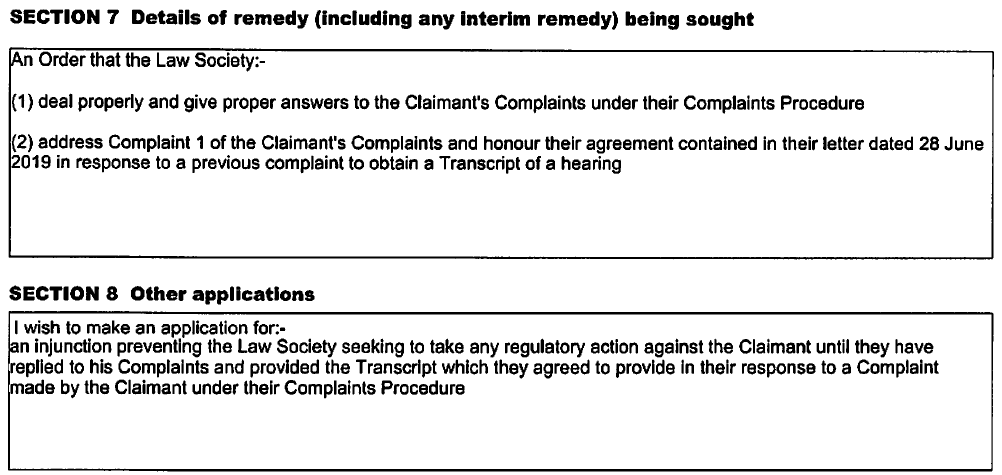
The regulator said that not only had they already sent a copy of the hearing transcript to Milne in March 2021 concluding that ‘this aspect of the claim is now redundant’, but that the correct response to the purported deficiency of their complaint response was to ‘to seek a review of its complaint handling by an Independent Reviewer’.
The regulator adds their:
…investigation has already been substantially delayed due to [Milne’s] complaints, which is contrary to the SRA’s public interest objectives, and there is now a pressing need to progress this.
The SRA submitted that the claim should be marked as ‘totally without merit’ as…
This claim is an abuse of the Court’s process.
[Milne] has recently issued another judicial review on similar grounds, which was also issued prematurely and failed to put forward arguable grounds for judicial review, and sought to achieve substantially the same outcome, namely a suspension of the regulatory investigation.
[Milne] appears to be using judicial review as a means of circumventing the regulatory process.
Costs of £3,180 and £1,733 were requested by the regulator for responding to the first and second judicial reviews respectively.
Taking Action
The filings reveal that the regulator was planning on taking action – and had informed Milne that they were minded to file a so-called rule 2.3 notice by 22nd March 2021, later changed to ‘early May 2021’. This is a formal notice of the allegations of professional misconduct.
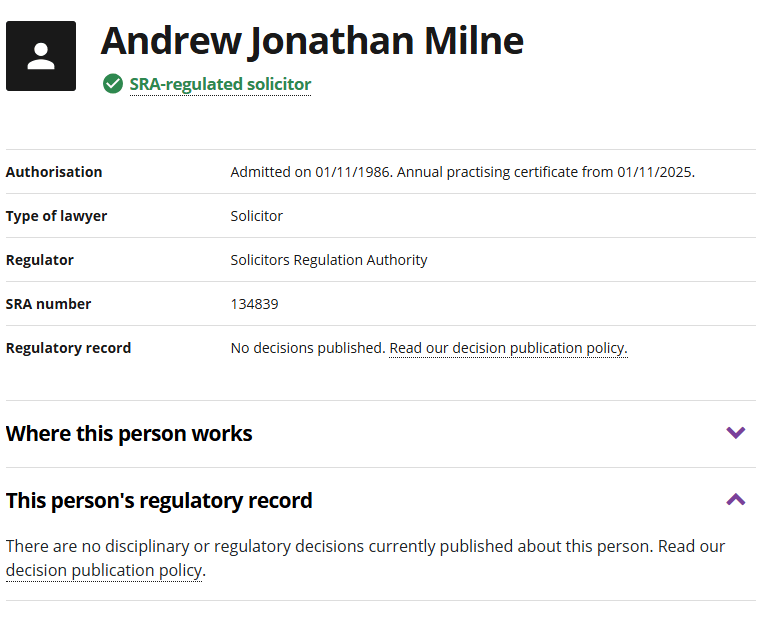
But, as of today’s date, his regulatory record appears clean.
Meanwhile, Milne continues to send ‘very aggressive‘ letters to his leaseholders, and journalists.
The SRA and SSB Group Limited
With no connection to Milne at all, it is worth mentioning that in October 2025 an independent review in the SRA’s regulation of SSB Group Limited was published.
Paragraph 5 of the independent report, about the SRA, is particularly damning:
The SRA failed to coherently draw together all the information which it held about SSB, failed to adequately assess the reports it received, and failed to carry out effective investigations in response to reports made to it about SSB.
The SRA therefore missed opportunities to take effective regulatory steps at an earlier stage to protect consumers and the public.
The report goes on to talk about how SSB’s “pursuit of thousands of claims, including many which appear to have had very limited or no prospects of success, also had a negative effect on the administration of justice more generally, since the unmeritorious claims took up valuable court time, as well as the time and costs incurred by defendants to defend the claims.“
We’re told “SSB’s treatment of its clients risks causing irreparable damage to the reputation of the solicitors’ profession generally and, by extension, the civil justice system“.
In response the chair of the SRA, Anna Bradley, said: “We are sorry that we did not act more quickly in relation to SSB, and that issues in our handling contributed to the harm and distress suffered by the many vulnerable consumers affected.“
Indeed.
On the subject of harm and distress 10-days before the publication of this article the Sheffield Tribune reported about an email Milne sent to a woman whose mother had recently passed away. The woman, named as Becky, has been told by Milne that he would “have a locksmith and agent attend [the mothers house] to recover possession … and change the locks”.
Despite the involvement of senior figures at the SRA, including Oliver Sweeney, then Head of Legal and Enforcement, and Rachel Pillinger, current Head of Corporate Complaints, Milne’s behaviour, in fact his entire style of litigation, has effectively been given the green light to carry on by an organisation with a legal duty to protect the public.
Accomplished investigative journalist and tax lawyer Dan Neidle has formed his own opinion of Milne in this Twitter/X thread, urging the SRA to take action:
A civil court has already found Milne to be dishonest. That should have immediately ended his career as a solicitor.
The public should be protected….
The Solicitors Regulation Authority should shut down his firm.
The SRA should impose immediate restrictions on Milne, suspending him from practising as a solicitor pending the outcome of an investigation.
In November 2025 Olivia Blake, MP for Sheffield Hallam, asked the Secretary of State for Justice, what discussions he has had with the SRA on steps to help reduce investigation times by the SRA.
Sarah Sackman MP replied variously ‘Given the independence of the regulators, it would not be appropriate for the Ministry of Justice to interfere with the process of the SRA’s investigations’.
SRA cover-up?
It is notable that the filing of two judicial review claims at the High Court against the regulator, in connection with their handling of complaints, were not mentioned in the SRA Corporate Complaints reports for years commencing November 2019, November 2020, November 2021 or November 2022.
On 29th October 2025 I wrote to the SRA, without informing them that I knew about the judicial review claims, and I said:
- I would specifically like to know whether the SRA considers it is meeting the objective set out on https://www.sra.org.uk/sra/how-we-work/ which states “Our purpose is to protect the public by ensuring that solicitors meet high standards, and by acting when risks are identified.”
- I would like to know if the SRA has tried to take action against him but been subject to threatened or actual legal actions?
Without answering my questions an SRA spokesperson said:
We are investigating before deciding on any next steps. It is only when we take action that it becomes a matter of public record.
When we said we didn’t feel our questions had been answered we were told:
As before, Daniel, it’s all we can say at this time.
We contacted the SRA again on the morning of Monday 24th November specifically putting some of the points raised, and sent with a copy of this article, inviting further comment. They did not send us a reply.
Andrew Milne was not contacted for comment.
Reporting by investigative journalist Daniel Cloake
This site is financed by donations to the Cheese Fund or you can buy me a coffee here
Feel free to contact me. Information received completely in confidence.
The work on this site is protected by copyright laws and treaties around the world. All such rights are reserved.
Our status (and that of any identified contributors) as the authors of content on our site must always be acknowledged.
You must not use any part of the content on our site for commercial purposes without obtaining a licence to do so from us or our licensors.
 Mouse in the Court
Amazing work – hugely impressed by your incredibly detailed investigation of this vile individual – you’re an absolute hero in Sheffield as well as UK wide I would think 👏
LikeLike