
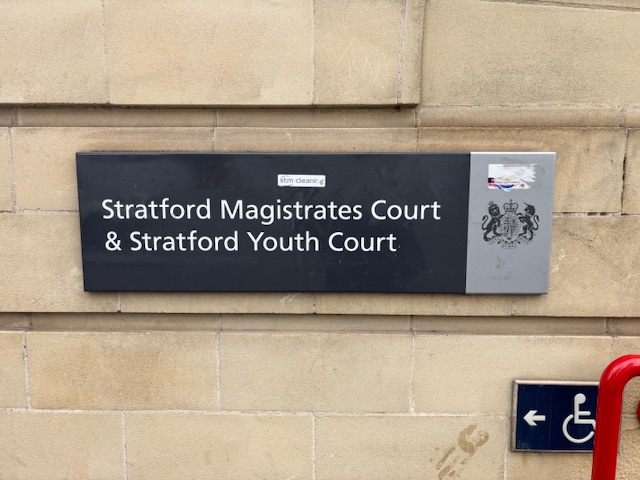
A morning at Stratford Youth Court saw a succession of cases involving young defendants, ranging from dangerous driving and possession of knives to criminal damage and drug offences.
Some matters were dealt with swiftly, while others were adjourned or referred for consideration of an out-of-court resolution. There were also moments of emotion, particularly when one young defendant was asked to apologise directly to his sobbing mother, who was sitting behind him in the courtroom.
I very nearly didn’t get in.
I faced what can only be described as outright hostility. “What case was I interested in”, I was asked. The 2pm sentencing I replied, but I’d like to sit in on the day’s list.
Why should I be allowed to attend? I’d like to say I gave a polished and elegant recital that the default position is that the press are entitled as of right to attend youth court hearings; that journalists perform a public watchdog function, etc; but alas time flew by and I couldn’t make notes.
The bench disappeared for several minutes to confer with the legal advisor. I wasn’t entirely sure what issue it was that perturbed them, suffice to say my submissions meant I was allowed to sit at the back.
A report in the Press Gazette from 2017 cites a District Judge who in hindsight realised she “had no legal authority to exclude the press [from the youth court] and they should have been allowed to attend under section 47 the Children and Young Persons Act 1933.”
The first defendant was a 16-year-old boy who, upon receiving positive GCSE results, had taken his mother’s car and driven it down the street, crashing into two vehicles in the process.
An immediate phone call to his mother with a remark of “words to the effect of ‘I fucked up'” was rather accurate.
What was notable was the speed at which this offence came before the court – the incident took place just 27 days ago.
This 16-year-old boy was joined today by his mother, who sat behind him in court. “My mum has given up everything for me. I want to put this behind me” he said.
Mrs Boyce JP, the chair of the three magistrates, asked him to turn and address the mum directly.
“Sorry, I’m sorry for everything I’ve done. I don’t want you to think less of me because of the situation. I want to say I’m really sorry.”
In what was quite an emotional moment, the mother started crying.
A 6-month referral order, with £85 costs and £26 surcharge, was accompanied by a 12-month driving disqualification order.
The boy, who was wearing a smart suit jacket was told “You’re very smartly dressed today. I like it.” by Mrs Boyce JP. “You too” the boy replied.
The next case had already been dealt with by way of an out-of-court resolution – a certificate confirming the fact had been emailed.
Unfortunately, the date of the offence had not been specified on the form, prompting Mr Kevin Kendridge, representing the Crown, to state: “I cannot say with any certainty whether this relates to the offence before me….In summary, I don’t wish to be unhelpful, but I’m not able to withdraw this offence.”
A further date in two weeks was set for the court to reconvene and process the certificate. “With respect, I don’t think this requires my attendance” said the defence solicitor. When told he had to attend he muttered “It’s a waste of public funds quite frankly”.
“At the end of the day we’re here to protect the young person” replied Mrs Boyce JP.
Next up was a 14-year-old boy who had been found with two lock knives in the Tower Hamlets area.
Each youth defendant had so far been asked the same question by Mrs Boyce JP – “Do you understand who’s who?” and given a whirl stop introduction of those in the courtroom.
“That gentleman right at the back, he’s from the press, so you have to behave” one 14-year-old was told. In some respects of course that’s the warning that should be given by the defendant towards the bench.
The defence had asked whether an out of court agreement would be possible in this case. The position of the Crown was that “given the type of weapon [this outcome] doesn’t look good” but “we have a duty to hear this out before we make a decision.”
Another possession of an offensive weapon charge was next, this time a machete, said to have been found in this defendant’s possession at Stratford station. He was currently in prison and it hadn’t been possible to arrange a remote link for him to join the hearing.
Hearing adjourned.
“Stand up please sir” asked Mrs Boyce JP. Unfortunately, the defendant was a 17-year-old girl.
The offence – that she had a kitchen knife in her waistband at 1 o’clock in the morning in Tower Hamlets – had been admitted.
Her lawyer explained that this was her client’s first time in court, she had “never been in trouble before” and had an “unblemished” record.
The reason given for the carrying of the knife, not for self-defence but to “feel protected”, was roundly dismissed by her own lawyer who said she had explained that “she could very well have been disarmed and attacked by the very knife she was carrying”.
The court was told that she had been “clearly traumatised by the death of a close friend” as a result of knife crime and had been urged to attend counselling.
The penalty for this offence, together with the offence of carrying a small amount of cannabis for personal use, was met with a 4-month referral order and payment of a £26 victim surcharge.
“The 13 hours you spent in the police station [was] torture enough” to avoid £85 prosecution costs, the court ruled.
A parting warning was given by Mrs Boyce JP about using cannabis: “it rots your brain”.
A 16-year-old girl was next – she was said to have smashed up the window(s) of her care home and assaulted a police officer.
Mr Kendridge, for the Crown, said “there are in the background considerable concerns about her wellbeing” citing a risk of exploitation.
Both the defence and the Crown were asked that the matter be referred to the CPS to be dealt with out of court.
Paperwork would need to be completed, including obtain the views of the care home and the police officer who was allegedly assaulted. A hearing was schedule in 6 weeks
“See you back here then. Well, hope we don’t see you” said Mrs Boyce JP as a parting message.
In the last case before lunch we had a 15-year-old boy, said to committed four driving offences.
We were told that a van had been seen by police who “felt the driver was very young, too young to drive a van”.
The van was pulled over and two people jumped out and ran off before being apprehended.
It will be for the Crown to prove that this defendant was the driver, not just a passenger, as a one-day trial to be held on 1st December 2026.
Stratford Youth Court
Courtroom 10
15th September 2026
Before Mrs Boyce JP (Chair), Mr Chesterton JP, Mrs Goodman JP
 Mouse in the Court