
The Serious Fraud Office has announced that 8 individuals connected to the failed investment firm London Capital & Finance have been charged with offences under the Fraud Act and the Proceeds of Crime Act.
The announcement was made on 16th November 2026, and in a blatant act of churnalism is reproduced below. Original content follows.
The Serious Fraud Office (SFO) has today [16/11/2026] charged eight individuals in connection with its investigation into the collapse of London Capital & Finance Plc (LCF).
Michael Andrew Thomson (53), Simon Hume-Kendall (73), Elten Barker (53), Paul Careless (51), Robert Sedgwick (78) and John Russell-Murphy (52) have each been charged with conspiracy to defraud. Helen Hume-Kendall (64) has been charged with concealing criminal property.
An eighth defendant has been charged with conspiracy to defraud and acting in contravention of a director disqualification undertaking. It is understood this individual’s legal team will make an application for anonymity at the first magistrates’ court hearing.
The charges follow the SFO’s investigation into LCF, which collapsed in 2019, leading to more than 11,200 investors losing an estimated £251 million.
LCF was a Tunbridge Wells-based investment company that raised money by selling mini-bonds to retail investors, marketed as a way to earn high returns.
All eight defendants are due to appear before Westminster Magistrates’ Court on 7 December 2026.
Emma Isaac, Head of Division for the Serious Fraud Office, said:
Thousands of investors believed backing London Capital & Finance would yield high returns, instead they lost over £250 million. Today’s charges mark a significant step forward in our investigation into the collapse of the firm and ensuring those responsible are held to account.
Press release ends.
So what happens next?
Conspiracy to defraud is a so-called indictable only offence. This means it can only be resolved at the Crown Court, and any trial must* be held with a jury.
[* jury reforms currently mooted would allow complex fraud trials to be held judge only, although whether this change will make it into law remains uncertain]
The hearing at Westminster Magistrates’ Court on 7th December 2026 will likely be a short administrative hearing to ‘send’ the case to the Crown Court, most likely Southwark.
The Crown Court is required to hold a pre-trial preparation hearing, or PTPH, within 35 days. So expect this to be held sometime in the week commencing 4th January 2027.
At the PTPH the defendants will normally be arraigned – so the charges will be put to each defendant to enter a guilty or not guilty plea. If guilty then the court will set directions to sentence, if not guilty then the court will set directions for trial.
The earlier a defendant pleads guilty, the more credit they can receive. A guilty plea at the first hearing would normally result in a one third discount.
Conspiracy to defraud carries anywhere from a discharge, to 10 years, guidance from the sentencing council suggests.
It is at the PTPH when we will really get a feel for how these proceedings are likely to proceed. If the matter goes to trial then don’t expect the cogs to turn quickly. The often unreliable crystal ball would suggest a trial date in mid-2028 or early 2029 as most likely.
In Spring 2027 the City of London Corporation is opening the City of London Law Courts comprising 8 Crown Courtrooms which “will focus on high-level fraud, cyber and economic crime.” A high profile case like this might be ideal to debut the new facilities so proceedings might not stay at Southwark.
Reporting restrictions
An essential ingredient in the fairness of a jury trial requires that the 12 members of the public hear all the evidence they will use in their decision-making in the courtroom, and not from elsewhere.
As a result strict reporting restrictions apply, effectively, to anything not said in front of the jury. This will include detailed reports of the first hearing at the Magistrates’, and any pre-trial hearings.
It can also prejudice the jury by talking about any related civil proceedings.
These automatic reporting restrictions are normal in all criminal cases and are lifted at the conclusion of the trial. As an example of what can be reported from the first hearing:
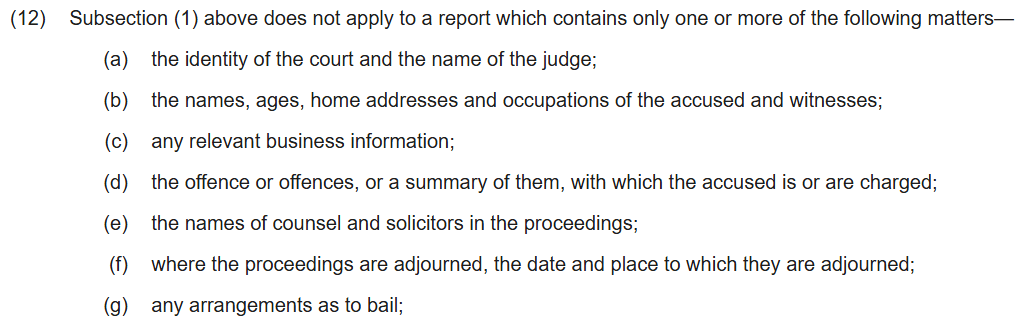
In 2022 this site crowdfunded donations from investors in the failed finance firm Collateral UK Limited to fund the attendance of journalists at every day of the trial. [Our coverage is linked to on this page]. It is likely the mouseinthecourt will consider doing a similar venture in this case, so watch this space.

