
The cost of obtaining copies of core court documents are increasing significantly notwithstanding repeated judicial statements stressing that meaningful public understanding of the justice system depends upon access to precisely these records.
Reporting by freelance journalist Daniel Cloake.
“Fine words butter no parsnips” said Lord Justice Toulson in his infamous opening paragraph of a judgment on open justice – and there has certainly been no shortage of fine words about the importance of public access to court documents.
Only six weeks ago, in a speech entitled ‘Open Justice and the Missing Dimension: Access to Documents in Civil Proceedings’ [Transcript here], Mr Justice Nicklin, Chair of the Transparency & Open Justice Board, warned that “if open justice does not follow the documents, it risks becoming an illusion rather than a reality”.
He also highlighted concerns that “open justice is most vulnerable not to overt restriction but to gradual erosion through the practical operation of modern procedures.”
Against that backdrop, HM Courts & Tribunals Service (HMCTS) have announced a 27% increase in the fee charged for copies of court documents.
A traditional civil claim requires the parties to serve various statements of case, often before the listings office even looks at the court diary.
[Legal boffins can see the underlying rule in CPR5.4C(1) coupled with the definition of statement of case in CPR2.3].
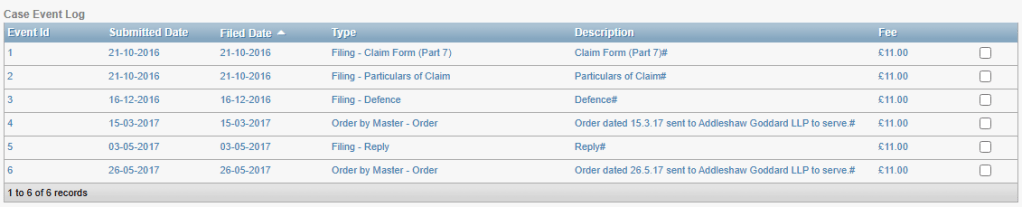
These documents include the claim form, particulars of claim, the Defence, and may include details of any counterclaims. The rule also mandates access to decisions of the court in the form of orders, or written judgments on file.
The importance of the provision of these types of documents to the public was underlined by Nicklin J in Hayden v Associated Newspapers Limited:
…the documents specified in [CPR5.4C(1)] are to be publicly accessible. They are the documents required to be available on the public record to enable the public scrutiny that is an essential feature of open justice. …
Nicklin J at [65] in Hayden v Associated Newspapers Limited & Anor [2022] EWHC 2693 (KB)
The mouseinthecourt expresses some bemusement therefore at the contrast between the punitive charging of fees disincentivising access to documents versus the positive promotion of open justice by senior members of the judiciary.
In 2021 the cost per document rose by 10%, from £10 to £11, as the so-called ‘online discount’ was removed.
At a debate in the House of Lords Lord Wolfson said it was “considered correct for those who can pay more than the actual cost of the process to do so” as “fees are the main source of direct income for courts” and the increase “will supplement the additional funding already being provided by the Government”.
Five years later and the price is rising again, this time by 27% to £14 per document. The increase will take effect from 13th July 2026, subject to parliamentary approval, HMCTS report.
It is already prohibitively expensive to obtain documents. A fairly standard set of pleadings, with a couple of court orders thrown in, will already set an interested non-party back £66, soon to be £84.
The price for copies of documents deployed in the Court of Protection is rising by 60%, from £5 to £8.
These costs should be compared to the American system PACER: “The cost to access a single document is capped at $3.00”, about £2.25 at date of publication, but “if you accrue $30 or less of charges in a quarter, fees are waived for that period.” It’s noted that “75 percent of PACER users do not pay a fee in a given quarter.”
In his speech, Nicklin J described PACER as “a world-leading model of public access to court electronic records” and observed that the challenge for England and Wales is not whether to replicate PACER, but “how to design our own digital justice system so that open justice is operational rather than theoretical.”
If that is the objective, increasing the cost of obtaining the very documents that enable the public to understand civil proceedings appears to move in the opposite direction. Claim forms, the Defence and court orders are not peripheral documents: they are the core records through which a case can be understood.
When senior judges warn that open justice is most vulnerable to gradual erosion through everyday practice, a 27% increase in the cost of accessing those documents looks uncomfortably like a practical example of the problem they have identified.
Both HMCTS and the Judicial press office were approached for comment. Neither provided one.
 Mouse in the Court